

- Audit Your Current Shopify B2B Features and Feature Gaps
- Architecting Company Profiles for Multi-Location Wholesale Accounts
- Implementation Checklist for Company Profiles
- Implementing Custom Price Lists: Fixed vs. Percentage-Based Discount Logic
- Configuring Net-Terms and Automated Payment Reminders
- Optimizing the B2B Checkout: Vaulted Cards and PO Workflows
- Transitioning from the Legacy Shopify Plus Wholesale Channel to Native B2B
- Common Pitfalls to Avoid
- How to Fix and Optimize
- Automating B2B Tax Exemptions and Customer-Specific Catalog Visibility
- Get a Professional Shopify Plus B2B Audit
- Related Shopify and Ecommerce Growth Guides
- Authoritative References
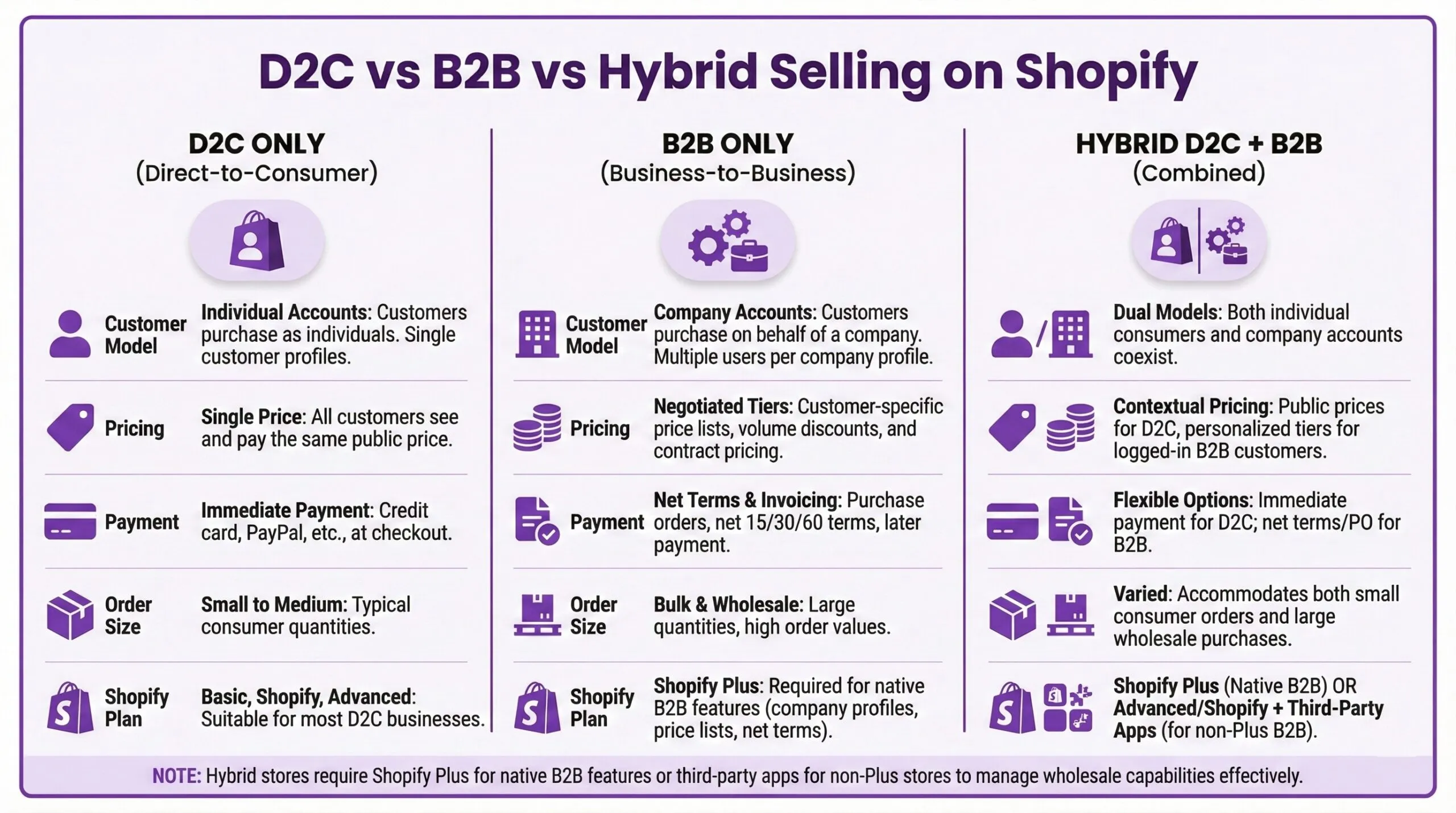
Legacy wholesale spreadsheets, manual invoicing, and fragmented third-party apps create massive operational overhead and data silos. For high-growth brands, scaling wholesale operations requires transitioning to a unified, automated system. This guide provides the technical steps and strategic insights needed to consolidate your wholesale operations into the native B2B environment on Shopify Plus.
Audit Your Current Shopify B2B Features and Feature Gaps
Shopify B2B wholesale optimization is the process of migrating manual spreadsheets, custom storefronts, and legacy apps into Shopify's native B2B features. This centralizes company profiles, price lists, and net terms directly within the Shopify admin, reducing operational overhead by automating customer-specific pricing, vaulted payment methods, and bulk ordering workflows for Plus merchants.
Before initiating your migration, perform a comprehensive audit of your current tech stack and operational workflows:
- Verify Shopify Plus Status: Ensure your account has active access to native B2B features. Note that while core B2B features are included in the standard Plus agreement, you should verify contract-specific pricing and feature availability directly with your Shopify account representative.
- Map Discount Tiers: Document your existing wholesale discount structures and map them to native Price Lists to eliminate manual entry.
- Identify Multi-Location Accounts: Group customers requiring multi-location shipping under a single parent company account.
- Review App Redundancies: Identify third-party wholesale apps (such as wholesale lock managers or custom pricing apps) that can be deprecated to improve site speed and reduce code bloat.
If you are currently using older wholesale solutions, review the Shopify Plus B2B vs. Handshake Migration Guide to plan a seamless transition without disrupting existing buyer relationships.
Architecting Company Profiles for Multi-Location Wholesale Accounts
Native B2B on Shopify Plus introduces a "Company" entity that sits above the traditional "Customer" level. This architecture enables a 1:N (one-to-many) relationship, allowing a single business entity to manage multiple buyers, shipping destinations, and billing terms.
To set up this structure correctly, follow these architectural guidelines:
- Assign Locations: Map specific physical locations to a company profile to manage distinct tax IDs, shipping addresses, and localized price lists.
- Define Company Contact Roles: Assign specific permissions to buyers. For example, allow some contacts to only view order history while granting others full purchasing and checkout permissions.
- ERP and CRM Integration: Use the unique Company ID as the primary key when syncing customer data with your ERP (such as NetSuite, SAP, or Microsoft Dynamics) or CRM systems. This ensures clean data mapping and prevents duplicate customer records.
Implementation Checklist for Company Profiles
- Create the Company profile within the Shopify Admin interface.
- Add "Locations" for each branch, retail store, or warehouse that the customer operates.
- Invite "Company Contacts" via email and assign them to their respective locations with appropriate permission levels.
- Establish a default payment term and tax exemption status for each location.
Implementing Custom Price Lists: Fixed vs. Percentage-Based Discount Logic
Price Lists allow you to override retail prices for specific B2B customers without creating duplicate SKUs or maintaining separate wholesale expansion stores. This keeps your inventory synchronized in real-time across both retail and wholesale channels. According to the official Shopify B2B documentation, you can configure two primary types of pricing logic:
- Fixed Prices: Best for MAP (Minimum Advertised Price) compliance and precision at the individual SKU level. This allows you to set exact dollar amounts for each product.
- Percentage-Based Discounts: Best for blanket category discounts or store-wide wholesale price reductions across large catalogs. You can apply a flat percentage discount to entire collections or the entire store.
For large catalogs, avoid manual admin entry. Instead, utilize CSV uploads or the Shopify Price List API to bulk-update prices. If your pricing logic involves complex volume breaks, tiered loyalty structures, or real-time ERP pricing calls, professional development support can help map legacy spreadsheet data to native Shopify fields without performance degradation.
Configuring Net-Terms and Automated Payment Reminders
Offering credit terms is a fundamental requirement for enterprise B2B transactions. Shopify B2B allows you to offer net terms directly at checkout, removing the need for manual invoicing, draft orders, or "pay later" workarounds that bypass the secure checkout flow.
To optimize your cash flow and reduce administrative overhead, implement the following automated workflows:
- Set Flexible Terms: Assign terms such as Net 15, Net 30, Net 60, or Due on Receipt at the Company Location level based on the buyer's creditworthiness.
- Automate Payment Reminders: Configure automated email notifications within Shopify to remind buyers of upcoming or overdue invoices (e.g., 3 days before the due date and 1 day after).
- Leverage Shopify Flow: Build automated workflows to tag companies with overdue balances, pause their ordering privileges, and alert your sales team for immediate follow-up.
Optimizing the B2B Checkout: Vaulted Cards and PO Workflows
A frictionless checkout experience is critical to prevent wholesale buyers from reverting to manual, email-based ordering. Streamline the purchasing process by enabling professional, enterprise-grade payment options:
- Vaulted Credit Cards: Allow trusted B2B customers to securely store their credit cards for one-click repeat ordering and automated balance settlement.
- Purchase Order (PO) Numbers: Enable PO field entry at checkout to satisfy internal procurement and accounting requirements for your corporate buyers.
- Minimum Order Quantities (MOQ): Set strict MOQs and order increments at the product or variant level to protect your wholesale margins and optimize shipping logistics.
When optimizing your checkout, monitor how third-party apps affect your page speed. Review Shopify CRO Apps vs Checkout Speed to ensure your optimization tools are not slowing down high-value wholesale buyers. Additionally, watch out for performance bottlenecks by reading Shopify Plus 'Hydration Hell': Fix CWV & Boost SEO to maintain a fast, responsive storefront.
Transitioning from the Legacy Shopify Plus Wholesale Channel to Native B2B
The legacy Shopify Plus Wholesale Channel (the separate, password-protected storefront) is being deprecated in favor of native B2B. Transitioning to native B2B allows you to use your primary, highly optimized theme for both retail and wholesale customers, creating a unified brand experience.
Common Pitfalls to Avoid
- Running Legacy Apps Concurrently: Running outdated wholesale apps alongside native B2B features often causes severe pricing logic conflicts and checkout errors.
- Manual Account Creation: Avoid manually creating customer accounts. Instead, utilize the native "Company" invitation flow to ensure buyers are correctly linked to their corporate profiles.
- Hard-Coding B2B Prices: Never hard-code wholesale prices or discount logic into your theme files. This creates massive technical debt and slows down site performance. Use the native Price List API and Liquid tags instead.
How to Fix and Optimize
Audit your theme for any custom code designed to hide prices or restrict access. Replace these legacy workarounds with native B2B Liquid tags that automatically detect if a logged-in user is an authorized Company Contact, displaying the correct price list and catalog dynamically. This unified approach also significantly improves your organic visibility; read our guide on Shopify B2B Technical SEO: Scale Wholesale Traffic to learn how to structure your storefront for maximum search engine performance.
Automating B2B Tax Exemptions and Customer-Specific Catalog Visibility
Manual tax reconciliation and catalog management are significant operational bottlenecks. Shopify B2B automates these processes by tying tax-exempt status and catalog visibility directly to the Company Location:
- Tax Exemption Certificates: Upload tax exemption certificates directly to the Company profile for clean, automated audit trails.
- Custom Catalogs: Use Catalogs to hide retail-only SKUs, seasonal items, or restricted products from specific wholesale buyers.
- Dynamic Linking: Link Catalogs directly to Price Lists to ensure the right customer automatically sees their negotiated rate upon logging in.
- Tax Validation Integrations: Automate tax ID validation through enterprise integrations like Avalara or Vertex if you operate across multiple tax jurisdictions.
When managing large volumes of product data and catalogs, be careful not to create duplicate, low-quality pages that harm your search rankings. Review AI Content for Shopify Plus: Prevent SEO Debt to learn how to scale catalog content safely without triggering search engine penalties.
Get a Professional Shopify Plus B2B Audit
Optimizing your B2B operations on Shopify Plus requires a careful balance of technical SEO, checkout performance, and clean ERP data integration. If you are planning a migration from a legacy wholesale channel or want to optimize your current Shopify B2B setup for maximum conversion and speed, let's connect. Contact me today for a comprehensive Shopify Plus B2B, SEO, and Migration Audit to ensure your store is built to scale efficiently.
Related Shopify and Ecommerce Growth Guides
- Shopify B2B Technical SEO: Scale Wholesale Traffic
- Shopify Plus B2B vs. Handshake: The Ultimate Migration Guide
- AI Content for Shopify Plus: Prevent SEO Debt [Guide]
- Shopify Plus 'Hydration Hell': Fix CWV & Boost SEO
- Shopify CRO Apps vs Checkout Speed: What to Audit
Authoritative References
Frequently Asked Questions
How do I migrate from the legacy Shopify Wholesale Channel to native B2B?
Migrating involves mapping your current customer data to the new 'Company' entity, setting up Price Lists to replace legacy discount codes, and updating your primary theme to use B2B-specific Liquid tags for dynamic price display.
How do Shopify Price Lists work for wholesale customers?
Shopify Price Lists are a core component of the native B2B environment, allowing merchants to create customer-specific pricing without duplicating SKUs or maintaining separate storefronts. Unlike traditional retail discounts, Price Lists enable fixed price overrides or percentage-based decreases across the entire catalog or specific collections. When a B2B customer logs in, Shopify’s logic automatically identifies their Company Profile and associated Price List, dynamically updating the storefront to display their negotiated rates. This system supports both simple percentage-off models for broad categories and granular, SKU-level fixed pricing required for MAP compliance. Furthermore, Price Lists can be combined with Catalogs to control product visibility, ensuring wholesale buyers only see relevant inventory. By utilizing CSV bulk uploads or the Price List API, Plus merchants can synchronize complex pricing tiers from an ERP directly into Shopify, eliminating manual data entry errors and providing a seamless, personalized purchasing experience for high-volume accounts.
Can I set minimum order quantities (MOQ) for B2B customers?
Yes, Shopify B2B allows you to set MOQs and increment rules at the product or variant level within the B2B catalog settings, ensuring wholesale orders meet your margin requirements and logistics constraints.

Ecommerce manager, Shopify & Shopify Plus consultant with 10+ years of experience helping enterprise brands scale their ecommerce operations. Certified Shopify Partner with 130+ successful store migrations.

