
- The Cognitive Cartography: Deconstructing User Intent Beyond Surface Metrics
- Building the Data Foundation: Architecting a Robust Shopify Plus Data Strategy
- Advanced Mapping Techniques: Unveiling User Paths and Pain Points
- Applying Cognitive Biases: Nudging Conversions on Shopify Plus
- Orchestrating Personalized Experiences at Scale
- Measuring the Impact: Advanced Attribution and Incrementality
- The Future of Cognitive Cartography: AI, Machine Learning, and Continuous Evolution
The Cognitive Cartography: Deconstructing User Intent Beyond Surface Metrics
From Clicks to Cognition: Understanding the 'Why' Behind User Actions
Cognitive Cartography represents a paradigm shift in conversion rate optimization for Shopify Plus. It moves beyond superficial metrics to map the intricate mental models, motivations, and decision-making processes of your users. This framework aims to uncover the deep "why" behind every click, scroll, and hesitation, transforming raw behavioral data into actionable insights about user intent.
Understanding user cognition means identifying not just what actions are taken, but the underlying needs, frustrations, and desires driving those actions. This holistic perspective is fundamental for advanced CRO Shopify Plus, enabling merchants to anticipate user needs and proactively optimize their digital experience.
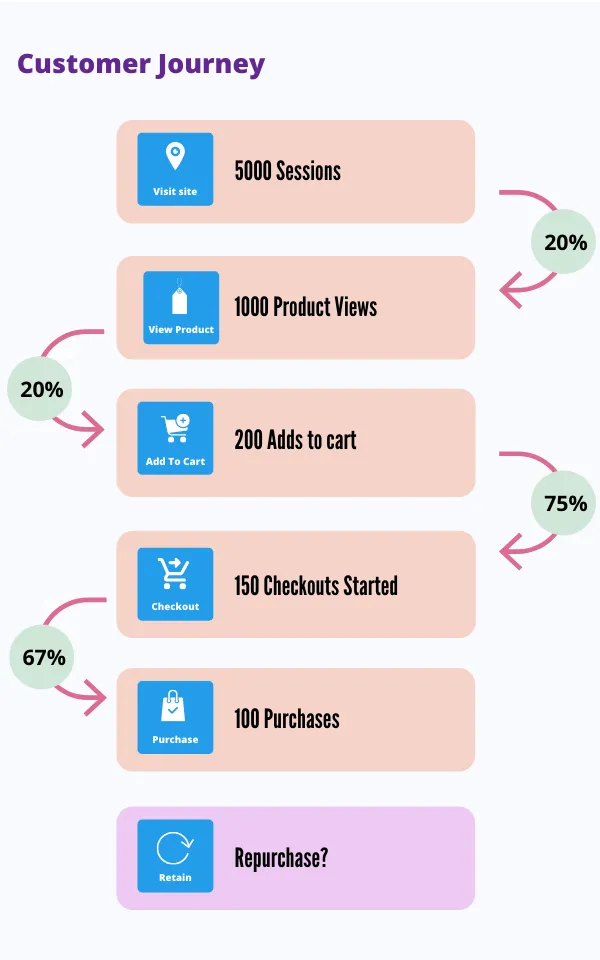 Shopify user behavior path mapping
The Limitations of Traditional Analytics for Deep Intent Discovery
Traditional analytics platforms, while essential for quantitative tracking, often fall short in revealing true user intent. They excel at reporting aggregate behaviors like bounce rates, page views, and conversion funnels, providing the "what" of user activity.
However, these tools typically lack the contextual depth to explain why users abandon carts, struggle with navigation, or fail to convert. Data often remains siloed, preventing a unified view of the customer journey, and making it challenging to infer unstated needs or pinpoint specific friction points driven by cognitive biases or design flaws.
Cognitive Cartography for Shopify Plus CRO transcends basic analytics by meticulously mapping user intent, moving beyond superficial metrics to understand the "why" behind every click and scroll. This advanced ecommerce data strategy integrates granular quantitative data analysis from GA4 event tracking with rich qualitative data analysis from heatmaps and session replays.
 Shopify behavioral data insights dashboard
By unifying data silos across Shopify Plus, CRM, and marketing platforms, merchants can build sophisticated customer journey mapping models. This enables segmentation strategies for Shopify Plus that micro-target intent-rich audiences, leveraging predictive analytics in ecommerce to anticipate future actions.
Applying principles of behavioral psychology in marketing – such as scarcity, social proof, and anchoring – allows for ethical nudging toward conversion. Through robust CRO experimentation frameworks and multi-touch attribution modeling, businesses can orchestrate truly personalized experiences at scale, proving tangible ROI on advanced CRO Shopify Plus initiatives. This holistic approach ensures sustained conversion rate optimization by continuously adapting to evolving user cognition.
Building the Data Foundation: Architecting a Robust Shopify Plus Data Strategy
Unifying Data Silos: Integrating Shopify Plus, CRM, and Third-Party Sources
A fragmented data landscape hinders deep intent discovery. The first architectural step for ecommerce data strategy is to unify all relevant customer data points into a single, comprehensive view. This involves integrating Shopify Plus transactional and behavioral data with customer relationship management (CRM) systems and other third-party platforms.
Key integration points include:
- Shopify Plus APIs & Webhooks: Utilize the Storefront and Admin APIs for real-time data extraction and synchronization. Webhooks can push event data to external systems upon specific triggers.
- CRM Systems: Connect Shopify Plus with platforms like Salesforce, Klaviyo, or HubSpot to merge purchase history with customer communication, support interactions, and marketing engagement data.
- Integration Platforms: Leverage tools such as Segment, Stitch, or Fivetran to centralize data from various sources into a data warehouse (e.g., Snowflake, Google BigQuery). This creates a single source of truth for advanced CRO Shopify Plus analysis.
This unification provides a 360-degree customer profile, essential for understanding the full context of user intent.
Granular Tracking & Event-Based Analytics (GA4 & Beyond)
Moving beyond basic pageview tracking is crucial for uncovering nuanced user intent. Google Analytics 4 (GA4), with its event-driven data model, is a powerful foundation for Shopify CRO at an advanced level.
Implement a comprehensive event tracking strategy:
- Standard E-commerce Events: Track
view_item_list,view_item,add_to_cart,begin_checkout,add_shipping_info,add_payment_info, andpurchase. Ensure accurate product data is passed with these events. - Engagement Events: Monitor
scrolldepth,video_engagement, form submissions, and specific button clicks (e.g., "Add to Wishlist," "Notify Me"). - Custom Events: Define events unique to your Shopify Plus store's functionality, such as filtering actions, product comparisons, or interactions with loyalty programs.
Utilize Google Tag Manager (GTM) for flexible and efficient deployment of these events, ensuring data accuracy and consistency across your ecommerce data strategy.
Leveraging Qualitative Data: Heatmaps, Session Replays, and Voice of Customer
While quantitative data reveals what is happening, qualitative data analysis explains why. Integrating qualitative insights is non-negotiable for true cognitive cartography.
- Heatmaps: Tools like Hotjar or Crazy Egg visualize user attention and interaction patterns. Click maps show where users click, scroll maps reveal content engagement, and move maps track mouse movements, inferring visual focus.
- Session Replays: FullStory or Clarity provide video recordings of actual user sessions. These replays expose friction points such as rage clicks, error messages, confusing navigation, or slow loading elements, offering invaluable context for conversion rate optimization.
- Voice of Customer (VoC): Implement on-site surveys, feedback widgets, and customer satisfaction (CSAT) prompts. Directly asking users about their goals, frustrations, and suggestions provides direct intent data. Analyze support tickets and chat logs for recurring pain points.
Combining these qualitative insights with quantitative data analysis provides a richer understanding of user behavior and underlying intent.
Advanced Mapping Techniques: Unveiling User Paths and Pain Points
Customer Journey Mapping with Behavioral Data
Beyond linear funnels, customer journey mapping visualizes the entire, often non-linear, path a user takes across all touchpoints. Using unified behavioral data, you can create nuanced maps that highlight key decision points, potential detours, and critical moments of truth.
Steps for effective journey mapping:
- Identify Key Stages: Define the typical stages from awareness to post-purchase loyalty.
- Map Touchpoints: Document every interaction point (website, email, social, ads, customer service).
- Integrate Behavioral Data: Overlay GA4 event data, CRM interactions, and qualitative feedback onto the journey. Analyze event sequences and user flows to identify common paths.
- Pinpoint Pain Points: Look for areas with high drop-off rates, excessive clicks, or negative sentiment from qualitative data. These are prime advanced CRO Shopify Plus opportunities.
This detailed mapping reveals where intent shifts or breaks down, guiding targeted Shopify CRO interventions.
Segmentation Strategies: Micro-Targeting Intent-Rich Audiences
Generic optimizations rarely yield significant results. Segmentation strategies for Shopify Plus move beyond basic demographics to create granular audience segments based on inferred intent and behavior. This allows for hyper-targeted personalization and optimization efforts.
Examples of intent-rich segments:
- High-Intent Abandoners: Users who viewed multiple products, added to cart, initiated checkout, but didn't complete.
- Category Explorers: Users who spent significant time browsing a specific product category or used category-specific search terms.
- Repeat Purchasers of Complementary Products: Customers likely to buy related items based on past purchases.
- Problem-Aware Shoppers: Users who searched for specific problems or solutions that your products address.
These segments are ideal for CRO experimentation frameworks, allowing you to test specific hypotheses tailored to their unique intent.
Predictive Analytics: Anticipating Future Actions and Opportunities
Predictive analytics in ecommerce takes intent mapping a step further by forecasting future user behavior. Leveraging historical data and machine learning models, businesses can anticipate customer needs, mitigate risks, and seize opportunities before they fully materialize.
Applications for Shopify Plus conversion rate optimization:
- Churn Prediction: Identify customers at risk of lapsing based on declining engagement or purchase frequency.
- Purchase Likelihood: Predict which users are most likely to convert in the near future, enabling targeted marketing and Shopify CRO nudges.
- Next Best Product Recommendations: Suggest products a customer is highly likely to purchase based on their browsing history, purchase patterns, and similar customer behavior.
- Optimal Discounting: Determine the minimum discount required to convert a specific user segment without eroding margins.
Integrating predictive analytics in ecommerce into your ecommerce data strategy allows for proactive, rather than reactive, optimization.
Applying Cognitive Biases: Nudging Conversions on Shopify Plus
Scarcity & Urgency: Ethical Implementation for CRO
Leveraging behavioral psychology in marketing involves understanding how cognitive biases influence decision-making. Scarcity and urgency, when applied ethically, can be powerful motivators for advanced CRO Shopify Plus efforts.
- Scarcity: Displaying "Only X items left in stock" or "Limited edition" can create a fear of missing out. Ensure these claims are genuine to maintain trust.
- Urgency: Time-sensitive offers like "Sale ends in X hours" or "Free shipping for the next 24 hours" encourage immediate action. Use countdown timers on product pages or in the cart.
Always prioritize transparency and authenticity. Misleading tactics erode trust and negatively impact long-term customer relationships, counteracting any short-term conversion rate optimization gains.
Social Proof & Authority: Building Trust Through Data
Humans are social creatures, heavily influenced by the actions and opinions of others. Social proof and authority are potent biases for building trust and encouraging conversions on Shopify Plus.
- Customer Reviews & Ratings: Display prominent product reviews, star ratings, and user-generated content (UGC). Tools like Loox or Yotpo integrate seamlessly with Shopify Plus.
- Popularity Indicators: "X people bought this recently," "Most popular product," or "Trending now" badges leverage herd mentality.
- Expert Endorsements & Certifications: Feature testimonials from industry experts, relevant certifications, or media mentions to establish authority.
- Influencer Marketing: Showcase collaborations with trusted influencers who align with your brand values.
These elements provide reassurance and validate purchase decisions, especially for new visitors.
Anchoring & Framing: Influencing Perception with Product Presentation
The way information is presented significantly impacts perception and value judgment. Anchoring and framing are subtle yet effective behavioral psychology in marketing tactics for Shopify CRO.
- Anchoring: Present a higher-priced item or package first to set an "anchor" price. Subsequent, more reasonably priced options then appear more attractive by comparison.
- Framing: Highlight benefits over features. Instead of "12-megapixel camera," frame it as "Capture stunning, professional-quality photos effortlessly."
- Value Bundling: Frame product bundles as a greater value proposition than purchasing items individually, even if the discount is marginal.
Strategic product presentation, informed by these biases, can subtly guide users towards higher-value conversions.
Orchestrating Personalized Experiences at Scale
Dynamic Content & Product Recommendations Driven by Intent
True personalization moves beyond basic "hello [name]" emails to serving dynamic content and product recommendations tailored to a user's inferred intent. This is where your ecommerce data strategy truly shines for advanced CRO Shopify Plus.
Implement personalized experiences based on segments and predictive insights:
- Personalized Homepages/Landing Pages: Display banners, hero images, and promotional content relevant to a user's browsing history or segment.
- Dynamic Product Recommendations: Use personalization engines for Shopify (e.g., Nosto, Klevu, Rebuy) to recommend products based on:
- Items viewed or added to cart.
- Purchase history.
- Products frequently bought together.
- Similar users' behavior.
- Tailored Search Results: Prioritize search results based on user preferences or past interactions.
This creates a highly relevant and engaging experience that resonates with individual user intent, significantly boosting conversion rate optimization.
A/B Testing & Multivariate Experimentation for Intent Validation
Hypotheses derived from cognitive cartography must be rigorously tested to validate their impact. CRO experimentation frameworks are the backbone of continuous improvement on Shopify Plus.
- A/B Testing: Test single variable changes (e.g., headline, CTA color, product image) to isolate their impact on conversion metrics.
- Multivariate Testing (MVT): For more complex changes involving multiple elements on a page, MVT can identify the optimal combination of variations.
- Experimentation Platforms: Utilize tools like Optimizely, VWO, or even Shopify's native A/B testing apps (where available for specific features).
- Hypothesis-Driven Approach: Every test should start with a clear hypothesis based on intent data (e.g., "Changing the CTA to X will increase add-to-cart rates for Y segment due to Z cognitive bias").
Documenting results and learnings from each experiment is crucial for building institutional knowledge and refining your ecommerce data strategy.
Leveraging Shopify Plus APIs and Apps for Advanced Personalization
Shopify Plus offers robust capabilities for implementing advanced personalization at scale. Understanding and leveraging its technical ecosystem is key.
- Storefront API: Develop custom frontend experiences that pull dynamic product data, customer-specific content, and real-time inventory information.
- Admin API: Manage customer data, orders, and product information programmatically, enabling seamless integration with external personalization engines for Shopify or custom applications.
- Shopify App Store: Explore a vast ecosystem of apps designed for personalization, recommendation engines, loyalty programs, and dynamic content. Evaluate apps based on their integration capabilities, performance impact, and scalability.
- Custom App Development: For highly unique personalization needs, consider developing custom Shopify apps that leverage your specific intent data and business logic.
A well-architected technical stack is critical for executing a sophisticated Shopify CRO strategy.
Measuring the Impact: Advanced Attribution and Incrementality
Moving Beyond Last-Click: Multi-Touch Attribution Models
Relying solely on last-click attribution for ecommerce data strategy often undervalues channels that contribute to earlier stages of the customer journey. For advanced CRO Shopify Plus, a more sophisticated understanding of marketing touchpoints is essential.
Explore and implement multi-touch attribution models:
- First-Click: Credits the initial touchpoint that brought the user to your site.
- Linear: Distributes credit equally across all touchpoints in the conversion path.
- Time Decay: Gives more credit to touchpoints closer to the conversion event.
- Position-Based (U-shaped): Assigns more credit to the first and last touchpoints, with the remaining credit distributed among middle interactions.
- Data-Driven Attribution (DDA): Uses machine learning to algorithmically assign credit based on actual user path data, often available in GA4 for sufficient data volumes.
These models provide a more accurate picture of which channels and CRO experimentation frameworks truly drive value.
Incrementality Testing: Proving the Value of CRO Initiatives
Correlation does not equal causation. Incrementality testing is vital to prove that your conversion rate optimization efforts are genuinely driving additional conversions, rather than just observing existing trends or reallocating existing demand.
How to approach incrementality:
- Control Groups: Create a true control group of users who are not exposed to your CRO initiative (e.g., a specific segment, geo-location, or randomized user cohort).
- A/B/C Testing: Compare a control (A), a test variation (B), and potentially another test variation (C) to measure the incremental lift.
- Geo-Testing: Roll out changes to specific geographic regions while holding others as a control.
- Pre/Post Analysis with Control: Compare performance before and after a change, but also compare it to a control group that didn't receive the change during the same period.
Proving incrementality is crucial for justifying advanced CRO Shopify Plus investments and scaling successful initiatives.
ROI Calculation for Advanced Data Strategy Investments
Demonstrating a clear return on investment (ROI) is paramount for securing continued resources for your ecommerce data strategy and Shopify CRO efforts. Move beyond vanity metrics to focus on tangible financial impact.
Key metrics for ROI calculation:
- Direct Conversion Uplift: The measurable increase in conversion rate directly attributable to your CRO efforts, translated into additional revenue.
- Average Order Value (AOV) Increase: If optimizations lead to customers purchasing more or higher-value items.
- Customer Lifetime Value (CLTV) Improvement: Enhanced experiences leading to higher retention and repeat purchases.
- Reduced Customer Acquisition Cost (CAC): More efficient conversion of traffic means lower cost per acquisition.
- Operational Efficiency Gains: Streamlined user flows can reduce support tickets or returns.
Present a comprehensive ROI analysis that clearly links your data strategy and conversion rate optimization initiatives to the bottom line.
The Future of Cognitive Cartography: AI, Machine Learning, and Continuous Evolution
AI-Powered Insights: Automating Intent Discovery
The future of cognitive cartography lies in the symbiotic relationship between human expertise and advanced AI/ML capabilities. AI can automate and scale many aspects of intent discovery, providing unprecedented speed and depth of insight for advanced CRO Shopify Plus.
- Automated Anomaly Detection: AI can quickly identify unusual user behaviors or performance drops that signal a shift in intent or a new friction point.
- Predictive Segmentation: Machine learning algorithms can dynamically create and refine customer segments based on evolving behavioral patterns, far beyond manual capabilities.
- Natural Language Processing (NLP): Analyze vast amounts of qualitative data (reviews, support tickets, survey responses) to extract sentiment, recurring themes, and latent intent.
- AI-Driven Hypothesis Generation: AI can suggest CRO experimentation frameworks based on identified intent gaps and predicted outcomes, accelerating the optimization cycle.
These AI-powered insights empower teams to focus on strategic implementation rather than manual data crunching, enhancing data visualization for CRO and actionable intelligence.
Building a Culture of Data-Driven Experimentation
Technology alone is insufficient. Sustained conversion rate optimization and cognitive cartography require a fundamental shift in organizational culture. Foster an environment where data-driven experimentation is not just a department function, but a core operating principle.
Key pillars of a data-driven culture:
- Cross-Functional Collaboration: Break down silos between marketing, product, development, and customer service teams. Share intent insights and experiment results openly.
- Continuous Learning: Embrace a mindset where every experiment, successful or not, is a valuable learning opportunity. Document findings and apply them to future strategies.
- Empowerment Through Data: Provide teams with the tools and training to access, interpret, and act upon data. Encourage hypothesis generation from all levels.
- Executive Buy-in: Secure leadership support for ecommerce data strategy investments and a commitment to long-term experimentation.
By embedding this culture, businesses can ensure that cognitive cartography becomes an intrinsic part of their journey towards unparalleled Shopify CRO success.
Frequently Asked Questions
What is Cognitive Cartography and how does it revolutionize Shopify Plus CRO?
Cognitive Cartography represents a transformative approach to conversion rate optimization (CRO) specifically for Shopify Plus merchants. Unlike traditional analytics that primarily report what users do (e.g., bounce rates, page views), Cognitive Cartography delves into the why behind user actions. It meticulously maps the intricate mental models, motivations, and decision-making processes of your customers. This involves integrating diverse data sources, from granular quantitative data (like GA4 event tracking) to rich qualitative insights (such as heatmaps, session replays, and voice of customer feedback). By unifying these data silos, businesses can build sophisticated customer journey maps, identify friction points driven by cognitive biases, and segment audiences based on inferred intent. The goal is to move beyond superficial metrics to understand underlying needs and desires, enabling proactive optimization of the digital experience. This holistic framework empowers Shopify Plus brands to orchestrate truly personalized experiences at scale, leading to sustained increases in conversion rates and a deeper understanding of their customer base.
How does an advanced ecommerce data strategy improve Shopify CRO?
An advanced ecommerce data strategy improves Shopify CRO by unifying disparate data sources (Shopify Plus, CRM, third-party apps) into a single source of truth. This allows for comprehensive customer journey mapping, granular event tracking (e.g., GA4), and sophisticated segmentation. By understanding the full context of user behavior and intent, merchants can identify precise optimization opportunities, personalize experiences, and implement targeted A/B tests that yield significant conversion lifts.
What role does behavioral psychology play in Shopify Plus conversion rate optimization?
Behavioral psychology is crucial in Shopify Plus CRO by leveraging cognitive biases to ethically influence user decisions. Principles like scarcity (e.g., "only X left"), urgency ("sale ends soon"), social proof (customer reviews, popularity indicators), and anchoring (strategic pricing presentation) can nudge users towards conversion. When applied transparently, these tactics build trust and encourage desired actions, enhancing the effectiveness of CRO initiatives.
How can AI and machine learning enhance conversion rate optimization for Shopify Plus?
AI and machine learning significantly enhance Shopify Plus CRO by automating intent discovery and scaling personalization efforts. They enable predictive analytics for churn or purchase likelihood, dynamic segmentation, and AI-driven hypothesis generation for A/B testing. NLP can analyze qualitative data for sentiment, while automated anomaly detection quickly flags shifts in user behavior. This allows teams to focus on strategic implementation, driving more efficient and impactful conversion rate improvements.

Ecommerce manager, Shopify & Shopify Plus consultant with 10+ years of experience helping enterprise brands scale their ecommerce operations. Certified Shopify Partner with 130+ successful store migrations.

![Shopify Plus: Map Risk to Revenue [Boost CRO & Profit]](img/blog/shopify-plus-risk-to-revenue-1.webp)
