
![The Strategic Debt Dividend: Agile Shopify Transitions [Phased Plan] Cover Image](/img/blog/strategic-debt-dividend-shopify-transition-1.webp)
- The Big-Bang Burnout Trap: Why Traditional Migrations Fail E-commerce
- Unpacking the hidden costs of all-at-once Shopify transitions
- The operational and psychological toll of high-stakes launches
- Deconstructing the Strategic Debt Dividend: A Proactive Approach to Shopify Growth
- Defining 'Strategic Debt Dividend' in the context of platform re-platforming
- How calculated delays generate future agility and financial returns
- Identifying Your 'Later Migration' Candidates: A Prioritization Framework for Shopify Plus
- Core functionalities vs. advanced features: The MVP-first mindset
- Assessing integration complexity and data dependencies for phased rollout
- User experience impact vs. backend system overhaul: Where to draw the line
- Crafting an Agile Shopify Transition: The Phased Implementation Blueprint
- Defining clear migration phases, milestones, and success metrics
- Resource allocation and team alignment for staggered releases
- Leveraging Shopify's modular architecture for iterative deployments
- Mitigating Risks and Maximizing Returns: Post-Migration Optimization & Monitoring
- Establishing performance benchmarks and continuous A/B testing protocols
- Iterative testing, user feedback loops, and rapid iteration cycles
- The long-term value of controlled technical debt and continuous improvement
- Real-World Applications: Case Studies in Calculated Later Migrations
- E-commerce brand X's inventory management system phased migration
- Brand Y's internationalization and multi-currency rollout strategy
- Beyond the Launch: Sustaining Agility and Scalability on Shopify Plus
- Related Reading
The Big-Bang Burnout Trap: Why Traditional Migrations Fail E-commerce
Traditional e-commerce platform migrations often follow a "big-bang" approach, attempting to transition an entire operational ecosystem in one monolithic launch. This strategy, while seemingly efficient on paper, frequently leads to catastrophic outcomes. The inherent complexity and interconnectedness of modern e-commerce operations make such all-at-once transitions a high-stakes gamble with significant downside.
Unpacking the hidden costs of all-at-once Shopify transitions
The allure of a clean break and a fresh start with a new Shopify Plus instance can be powerful. However, the hidden costs associated with a full-scale, simultaneous Shopify transition are substantial and often underestimated. These go far beyond direct development and licensing fees.
Exploding server e-commerce migration failure
- Extended Downtime Risk: A single point of failure can halt all operations, leading to immediate revenue loss and customer frustration. The pressure to minimize this window often compromises quality assurance.
- Massive Resource Drain: All teams – marketing, operations, product, customer service – are pulled into the migration vortex. This diverts critical personnel from daily revenue-generating activities and strategic initiatives.
- Compromised Data Integrity: Migrating vast datasets simultaneously increases the risk of corruption, loss, or misalignment. Reconciling discrepancies post-launch can be an enormous, time-consuming effort.
- Integration Overload: Attempting to re-establish and test every third-party integration (ERP, CRM, OMS, PIM, payment gateways) simultaneously creates an exponential increase in potential failure points.
- Post-Launch Bug Fixes: The sheer volume of new code and configurations almost guarantees a lengthy period of post-launch firefighting. This consumes development resources and impacts user experience.
These hidden costs erode profitability and operational stability, turning a planned upgrade into a prolonged recovery mission.
The operational and psychological toll of high-stakes launches
Beyond the financial implications, the human element of a big-bang migration cannot be overstated. The pressure on teams leading up to and immediately following launch is immense, often unsustainable. This leads directly to burnout and diminished long-term performance.
- Team Burnout: Extended work hours, constant problem-solving, and the fear of failure take a severe toll on development, QA, and operations teams. This can lead to high turnover and decreased morale.
- Decision Paralysis: The need to make hundreds of critical decisions under extreme time pressure often results in suboptimal choices. Teams become risk-averse, delaying necessary actions.
- Customer Service Strain: Post-launch issues inevitably flood customer service channels. Agents, often inadequately trained on the new system's nuances, face an uphill battle, damaging brand reputation.
- Loss of Focus: The all-consuming nature of a big-bang launch means strategic initiatives, marketing campaigns, and product development often get deprioritized or shelved. This creates a market opportunity cost.
- Stakeholder Anxiety: Senior leadership and investors experience heightened anxiety as significant capital and brand reputation hang in the balance. This can lead to micromanagement and stifle innovation.
The operational and psychological toll of these high-stakes launches can cripple an organization's ability to innovate and scale effectively for months, if not years, after the fact.
![Agile Shopify phased transition blueprint - The Strategic Debt Dividend: Agile Shopify Transitions [Phased Plan]](/img/blog/strategic-debt-dividend-shopify-transition-2.webp) Agile Shopify phased transition blueprint
Agile Shopify phased transition blueprint
Deconstructing the Strategic Debt Dividend: A Proactive Approach to Shopify Growth
Recognizing the inherent flaws in big-bang migrations, we introduce the concept of the "Strategic Debt Dividend." This framework reframes certain delayed migrations not as technical debt to be avoided, but as a calculated investment. It yields significant operational agility and financial returns by proactively preventing big-bang burnout and facilitating iterative growth.
Defining 'Strategic Debt Dividend' in the context of platform re-platforming
Strategic Debt Dividend refers to the conscious decision to defer the migration or re-platforming of specific, non-critical functionalities or integrations. This calculated delay allows the core platform to launch with minimal complexity, enabling faster time-to-market and immediate value realization. By breaking down a monolithic platform re-platforming into manageable, phased components, businesses can strategically accrue "debt" in the form of deferred tasks. This debt is then "paid off" incrementally, yielding a "dividend" of reduced risk, enhanced agility, and optimized resource utilization for a smoother overall Shopify transition.
The Strategic Debt Dividend framework actively leverages the concept of a technical debt management strategy, transforming it from a reactive burden into a proactive strategic tool. It's about making deliberate choices to prioritize immediate core functionality over comprehensive, simultaneous feature parity. This approach minimizes initial launch risk, accelerates the delivery of an MVP (Minimum Viable Product), and allows for dedicated focus on critical systems. The dividend is realized through reduced post-launch chaos, more efficient resource allocation, and the ability to adapt to market changes with greater speed and precision. This calculated deferment also fosters an environment of continuous improvement and iteration, rather than a one-time, high-pressure event, ultimately enhancing long-term platform stability and scalability.
How calculated delays generate future agility and financial returns
Embracing a later migration strategy transforms the re-platforming narrative. It shifts from a reactive scramble to a proactive, controlled evolution. This approach inherently builds future agility into your operational DNA.
- Reduced Initial Complexity: Launching with a lean, MVP (Minimum Viable Product) strategy reduces the number of variables. This makes the initial launch more stable and easier to troubleshoot.
- Faster Time-to-Market: By focusing only on essential functionalities, your core Shopify store can go live sooner. This allows you to start generating revenue and gathering real-world user data without delay.
- Optimized Resource Allocation: Teams aren't stretched thin across myriad tasks. They can dedicate focused effort to critical components, improving quality and reducing errors. This is crucial for effective resource allocation planning.
- Enhanced Learning & Iteration: Post-launch, you gain invaluable insights from live user interactions. This data informs subsequent agile development methodology cycles, ensuring later migrations are more precise and impactful.
- Mitigated Financial Risk: Spreading investment over time reduces the immediate capital outlay and financial exposure of a single, large project. It allows for better budget control and demonstrable ROI on each phase.
- Improved Team Morale: Smaller, more frequent successes replace the overwhelming pressure of one huge launch. This fosters a positive, iterative work environment.
This strategic deferment cultivates a continuous improvement mindset, ensuring that each subsequent phase of your Shopify scalability planning is more informed and successful.
Identifying Your 'Later Migration' Candidates: A Prioritization Framework for Shopify Plus
The success of the Strategic Debt Dividend hinges on intelligent prioritization. Not everything can or should be deferred. A robust framework is essential for identifying which components are prime candidates for a phased implementation plan.
Core functionalities vs. advanced features: The MVP-first mindset
Adopt an MVP-first mindset when approaching your Shopify transition. Distinguish between what is absolutely essential for your store to operate and transact, and what constitutes an enhancement or advanced capability. The goal is to get a stable, revenue-generating platform live as quickly as possible.
- Core Functionalities (Immediate Migration):
- Product catalog display and basic search.
- Shopping cart and checkout process.
- Primary payment gateway integration.
- Order management and fulfillment basics.
- Customer account creation and login.
- Essential shipping calculation and methods.
- Advanced Features (Later Migration Candidates):
- Complex personalization engines.
- Advanced loyalty programs and rewards.
- Multi-currency or multi-language support (unless core to initial market).
- Sophisticated inventory management systems (beyond basic Shopify capabilities).
- Highly customized product builders or configurators.
- Subscription management platforms.
- Advanced analytics dashboards and reporting beyond Shopify's native tools.
This clear demarcation allows you to define your true MVP for initial launch, deferring complexity until the core is proven stable.
Assessing integration complexity and data dependencies for phased rollout
Integrations are often the most fragile and time-consuming aspects of a platform re-platforming. Evaluate each third-party system based on its complexity and its data dependencies. This assessment helps determine suitability for staged deployment.
- High Complexity/High Dependency (Later Migration):
- ERP systems with bidirectional data flow and custom logic.
- Legacy PIM systems requiring extensive data transformation.
- Complex WMS (Warehouse Management Systems) with real-time inventory sync.
- Custom-built CRM platforms with deep customer journey mapping.
These systems often require dedicated development sprints, thorough testing, and potential middleware solutions. Migrating them later allows for focused attention and iterative refinement.
- Low Complexity/Low Dependency (Immediate Migration if Critical):
- Standard payment gateways (e.g., Stripe, PayPal).
- Basic email marketing integrations (e.g., Klaviyo, Mailchimp).
- Simple analytics tracking (e.g., Google Analytics).
These are often well-documented APIs or app store integrations, posing less initial risk.
Map out your entire integration landscape. Prioritize based on direct impact on transactional success versus incremental operational efficiency or advanced functionality.
User experience impact vs. backend system overhaul: Where to draw the line
When deciding on later migration candidates, consider the immediate impact on the customer-facing user experience versus the behind-the-scenes backend system overhaul. Prioritize a seamless front-end experience for initial launch.
- Front-End (Immediate Migration):
- Intuitive navigation and search.
- Clean product pages with clear imagery and descriptions.
- A frictionless checkout flow.
- Responsive design across devices.
These directly influence conversion rates and customer satisfaction. Any disruption here is immediately felt and can be costly.
- Backend (Later Migration Candidates):
- Refactoring of complex internal reporting tools.
- Overhauling legacy order routing logic.
- Implementing new fraud detection systems.
- Integrating advanced inventory allocation algorithms.
While critical for long-term efficiency, these can often be managed manually or through existing systems in the short term, provided they don't impede core transactional processes. This allows for dedicated focus on post-migration optimization of the customer journey.
The line should be drawn where backend complexities begin to directly impede the core customer journey or present an unacceptable risk mitigation strategy for the initial launch.
Crafting an Agile Shopify Transition: The Phased Implementation Blueprint
An agile approach to your Shopify transition requires a meticulously crafted phased implementation plan. This blueprint breaks down the migration into manageable sprints, each with defined goals and success metrics. It fosters iterative progress and allows for continuous adaptation.
Defining clear migration phases, milestones, and success metrics
A successful staged deployment starts with a clear roadmap. Each phase must have distinct objectives, measurable outcomes, and a defined scope. This structure ensures accountability and provides clear progress indicators.
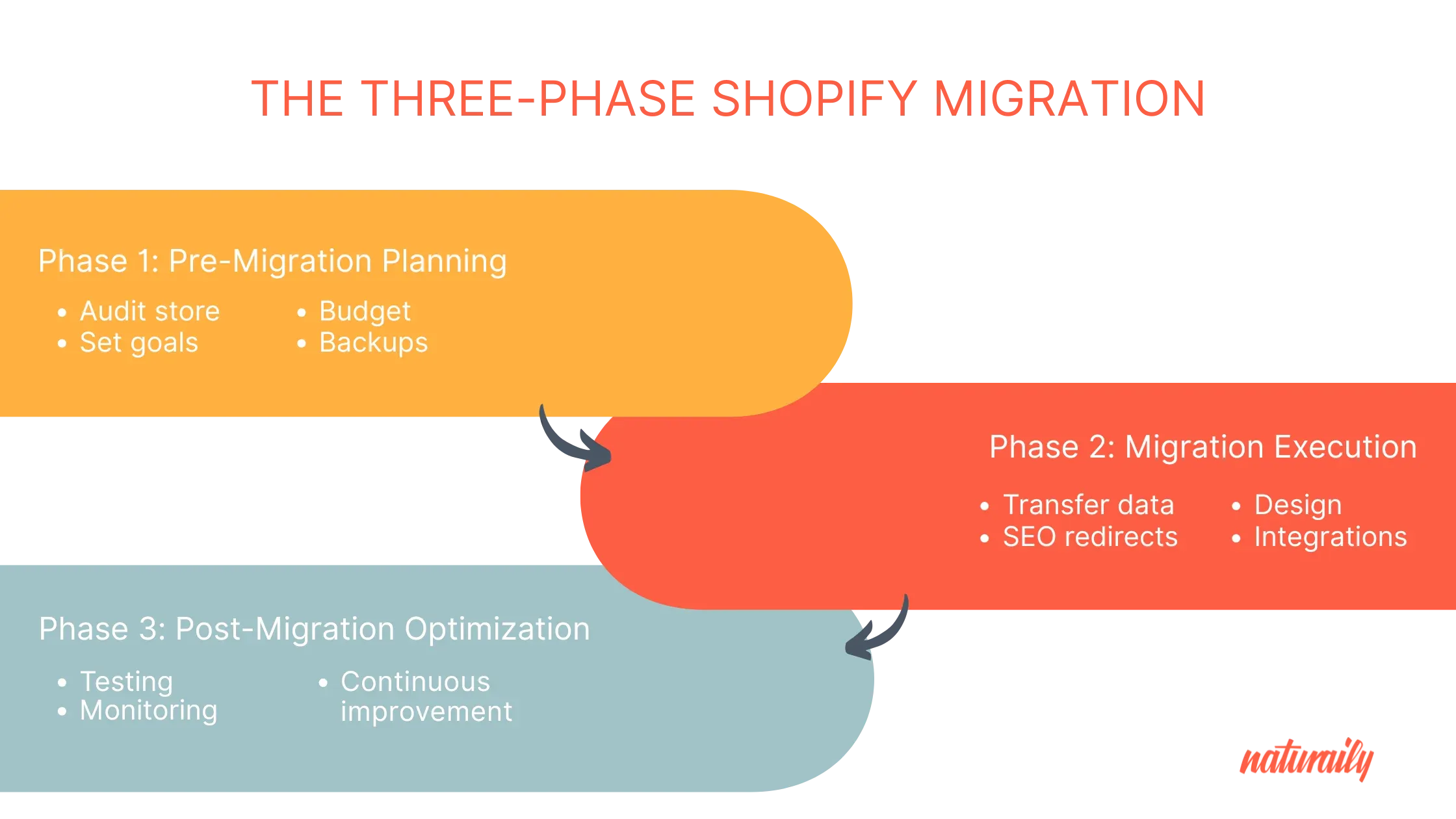
- Phase 1: Foundation & MVP Launch
- Objective: Launch a fully functional, stable Shopify store with core e-commerce capabilities.
- Milestones: Core product catalog migrated, checkout live, primary payment gateway functional, essential customer accounts active.
- Success Metrics: Transactional success rate > 99%, uptime > 99.9%, initial conversion rate baseline established.
- Phase 2: Critical Integrations & Operational Efficiency
- Objective: Integrate essential backend systems that significantly improve operational efficiency.
- Milestones: ERP/OMS integration complete, basic inventory sync, core shipping carrier APIs connected.
- Success Metrics: Order processing time reduced by X%, inventory accuracy > Y%, fulfillment error rate < Z%.
- Phase 3: Advanced Features & Customer Experience Enhancements
- Objective: Implement advanced functionalities that enhance the customer journey and drive retention.
- Milestones: Loyalty program launched, personalization engine live, multi-currency/language deployed (if applicable).
- Success Metrics: AOV increased by X%, repeat purchase rate improved by Y%, customer lifetime value (CLTV) growth.
This iterative process allows for continuous evaluation and adjustment, embodying true agile development methodology.
Resource allocation and team alignment for staggered releases
Effective resource allocation planning is paramount for a successful later migration. Rather than a single, all-hands-on-deck push, teams are deployed strategically across phases. This requires careful change management in e-commerce.
- Dedicated Phase Teams: Assign smaller, cross-functional teams to each migration phase. This ensures focused expertise and reduces context switching.
- Clear Roles and Responsibilities: Define who is responsible for what in each phase, from project management to QA and deployment.
- Staggered Development Cycles: Plan development and testing for subsequent phases to begin as previous phases stabilize. This prevents bottlenecks and optimizes developer bandwidth.
- Continuous Communication: Implement robust communication channels between all stakeholders. Regular stand-ups, progress reports, and feedback sessions are vital.
- Training and Documentation: Ensure that operational teams receive ongoing training for new features as they are released. Comprehensive documentation prevents knowledge silos.
This staggered approach prevents team burnout and allows for a more sustainable pace of development and deployment.
Leveraging Shopify's modular architecture for iterative deployments
Shopify's inherent modularity, especially with Shopify Plus, is a key enabler for phased implementation plans. Its app ecosystem, API-first approach, and theme architecture facilitate iterative deployments.
- App Store Leverage: Utilize existing Shopify apps for non-core functionalities. This reduces custom development burden and allows for quick integration of features like reviews, wishlists, or basic loyalty programs.
- Headless/API-First Approach: For complex front-end requirements or integrations, Shopify's Storefront API and Admin API allow for decoupling the frontend from the backend. This enables independent development and deployment of specific components.
- Theme Sections and Blocks: Shopify's theme architecture, particularly with OS 2.0, allows for modular theme development. New sections or blocks can be developed and deployed incrementally without affecting the entire site.
- Flow and Scripts: Shopify Flow and Script Editor (for Plus) enable automation and customization of business logic without extensive code changes. These can be introduced or refined in later phases.
- Multiple Sales Channels: Shopify supports multiple sales channels. You can migrate your primary storefront first, then incrementally integrate other channels (e.g., social commerce, marketplaces) in subsequent phases.
This inherent flexibility allows merchants to deploy small, tested changes frequently, minimizing risk and maximizing agility.
Mitigating Risks and Maximizing Returns: Post-Migration Optimization & Monitoring
The launch of your core Shopify store is not the finish line; it's the start of a new phase of continuous improvement. Effective post-migration optimization and rigorous monitoring are critical for realizing the full Strategic Debt Dividend. This involves proactive testing, user feedback integration, and strategic technical debt management.
Establishing performance benchmarks and continuous A/B testing protocols
Immediately post-launch, establish baseline performance benchmarks across key metrics. These benchmarks are crucial for measuring the impact of subsequent later migration phases and optimization efforts.
- Key Performance Indicators (KPIs): Monitor conversion rate, average order value (AOV), bounce rate, page load speed, cart abandonment rate, and customer acquisition cost (CAC).
- Analytics Setup: Ensure comprehensive tracking with tools like Google Analytics 4, Shopify Analytics, and heat mapping software. This provides granular data on user behavior.
- A/B Testing Framework: Implement a robust A/B testing protocol. Every significant feature addition or design change from a phased implementation plan should be tested against the baseline.
- Hypothesis-Driven Testing: Formulate clear hypotheses before running tests (e.g., "Adding X feature will increase conversion by Y%"). This ensures tests are meaningful and results are actionable.
- Continuous Monitoring: Utilize uptime monitoring, error logging, and performance monitoring tools to proactively identify and address issues.
This data-driven approach ensures that every subsequent iteration contributes positively to your bottom line.
Iterative testing, user feedback loops, and rapid iteration cycles
The agile nature of a later migration demands continuous, iterative testing and a strong emphasis on user feedback. This creates a virtuous cycle of improvement.
- Pre-Launch UAT (User Acceptance Testing): For each new feature or integration deployed in a later phase, conduct thorough UAT with internal stakeholders and a select group of beta users.
- Post-Launch Monitoring & QA: After a feature goes live, continue to monitor its performance and conduct ongoing QA. No deployment is truly "done."
- User Feedback Channels: Establish clear channels for collecting customer feedback: on-site surveys, customer service interactions, social media monitoring, and user forums.
- Rapid Iteration Cycles: Based on testing results and user feedback, prioritize and implement rapid iterations. Small, frequent updates are less risky and easier to manage than large, infrequent ones.
- Bug Reporting & Resolution: Implement a clear process for reporting, tracking, and resolving bugs identified through testing or user feedback.
This continuous loop ensures that your platform evolves in direct response to user needs and market demands, embodying true agile development methodology.
The long-term value of controlled technical debt and continuous improvement
The Strategic Debt Dividend framework champions the idea that not all technical debt is bad. Controlled, conscious technical debt management can be a powerful strategic tool. It allows for faster initial deployment and informs future development.
- Informed Refactoring: By deferring certain complex functionalities, you gain real-world usage data. This data guides more effective refactoring and optimization when those features are eventually migrated or built.
- Avoidance of Premature Optimization: Delaying certain features prevents investing heavily in solutions that may not align with actual user behavior or future business needs.
- Resource Reallocation: The ability to defer allows you to reallocate development resources to more pressing, high-impact areas as they emerge.
- Sustainable Growth: A culture of continuous improvement, fueled by iterative deployments and feedback, is more sustainable than periodic, stressful big-bang launches. This is key for Shopify scalability planning.
- Reduced Risk Exposure: Spreading out the deployment of complex systems reduces the overall risk profile, allowing for focused risk mitigation strategy efforts on individual components.
Embracing controlled technical debt as a strategic asset ultimately leads to a more resilient, adaptable, and profitable e-commerce operation.
Real-World Applications: Case Studies in Calculated Later Migrations
To illustrate the power of the Strategic Debt Dividend, let's examine hypothetical scenarios where e-commerce brands successfully leveraged later migration strategies. These examples highlight how phased approaches can mitigate risk and drive growth for complex Shopify transition projects.
E-commerce brand X's inventory management system phased migration
Brand X, a rapidly growing apparel retailer, faced the challenge of migrating from a legacy Magento platform to Shopify Plus. Their existing inventory management system (IMS) was heavily customized and deeply integrated with their ERP, featuring complex allocation rules and multi-warehouse logic. A big-bang migration would have jeopardized their peak season sales.
- Initial Phase (MVP Launch): Brand X launched its core Shopify Plus store with basic product display, checkout, and order capture. For inventory, they initially relied on a simplified, manual sync process for primary stock levels, accepting a temporary increase in manual oversight. Their existing IMS continued to manage advanced allocations in the background, with only essential data flowing to Shopify.
- Later Migration Phase (IMS Integration): Six months post-launch, after the core Shopify store was stable and performing well, Brand X dedicated a specialized team to fully integrate their IMS. This involved building a robust, bidirectional API connection, migrating complex inventory rules, and rigorous testing in a staging environment. The phased approach allowed them to focus solely on the IMS integration without concurrent pressure from other migration tasks.
- Outcome: By deferring the complex IMS migration, Brand X achieved a rapid, stable launch for their core e-commerce operations, capturing crucial holiday sales. The dedicated IMS integration phase was executed with fewer errors and less stress, resulting in a highly optimized and accurate inventory system that now seamlessly supports their growth on Shopify Plus. This strategic delay yielded significant financial and operational dividends.
Brand Y's internationalization and multi-currency rollout strategy
Brand Y, a specialty electronics retailer, planned to expand into three new international markets while simultaneously replatforming to Shopify Plus. Launching all new markets and their respective multi-currency/multi-language capabilities at once was deemed too risky due to the complexity of localized pricing, tax rules, and shipping logistics.
- Initial Phase (Domestic MVP Launch): Brand Y first launched their Shopify Plus store for their primary domestic market, focusing on optimizing the core user experience and ensuring seamless order fulfillment within their established region. This allowed them to validate the new platform's stability and performance without the added layers of international complexity.
- Later Migration Phase 1 (First International Market): Three months after the domestic launch, they introduced their first new international market. This involved integrating a multi-currency solution, localizing content for that specific region, and setting up localized shipping rates. The lessons learned from this single market rollout provided invaluable insights for subsequent expansions.
- Later Migration Phase 2 & 3 (Subsequent International Markets): Building on the success and learnings from the first international market, Brand Y incrementally rolled out the remaining two markets over the next six months. Each rollout benefited from refined processes, templates, and a clearer understanding of the challenges.
- Outcome: This staged deployment significantly reduced the risk associated with a simultaneous global launch. Brand Y avoided potential reputational damage from errors in multiple markets, optimized their internationalization strategy iteratively, and ensured each new market launch was progressively smoother and more successful. The calculated deferment delivered a substantial Strategic Debt Dividend in terms of market penetration and operational efficiency.
Beyond the Launch: Sustaining Agility and Scalability on Shopify Plus
The Strategic Debt Dividend framework extends far beyond the initial Shopify transition. It cultivates a mindset of continuous improvement and strategic iteration, which is fundamental for sustaining agility and achieving long-term Shopify scalability planning. Your platform is a living asset, not a static destination.
Embrace the philosophy that your Shopify Plus instance will perpetually evolve. Regularly audit your technical stack, re-evaluate integrations, and assess emerging market trends. This proactive approach ensures that your initial Strategic Debt Dividend continues to pay returns, preventing the accumulation of unmanaged technical debt. By maintaining an agile development methodology, you position your e-commerce operation to adapt quickly to new opportunities and overcome unforeseen challenges. This continuous optimization loop is the true hallmark of a high-performing enterprise merchant.
Frequently Asked Questions
What is the "Strategic Debt Dividend" in e-commerce?
The 'Strategic Debt Dividend' is a framework that redefines certain delayed migrations not as traditional technical debt, but as a calculated investment. It involves consciously deferring the migration or re-platforming of specific, non-critical functionalities or integrations. This deliberate delay allows the core e-commerce platform, such as a Shopify store, to launch with minimal complexity, enabling faster time-to-market and immediate value realization. By breaking down a monolithic platform re-platforming into manageable, phased components, businesses strategically accrue 'debt' in the form of deferred tasks. This debt is then 'paid off' incrementally, yielding a 'dividend' of reduced initial risk, enhanced operational agility, and optimized resource utilization. This approach minimizes launch chaos, accelerates the delivery of a Minimum Viable Product (MVP), and fosters continuous improvement rather than a single, high-pressure event, ultimately enhancing long-term platform stability and scalability.
How does a phased implementation plan reduce risk for Shopify migrations?
By breaking down the migration into smaller, manageable stages, a phased plan reduces the complexity and potential points of failure associated with a "big-bang" launch. Each phase can be thoroughly tested and optimized before moving to the next, minimizing downtime, resource drain, and post-launch issues. This iterative approach allows for continuous learning and adaptation, significantly lowering financial and operational risks.
Which types of features are best suited for a "later migration" on Shopify Plus?
Features best suited for later migration are typically advanced functionalities or complex integrations that are not critical for the initial launch of a Minimum Viable Product (MVP). Examples include highly customized personalization engines, advanced loyalty programs, multi-currency/multi-language support (unless core to the initial market), sophisticated inventory management systems beyond basic Shopify capabilities, and complex ERP/CRM integrations with extensive data dependencies. Prioritizing core transactional functionalities first ensures a stable initial launch.

Ecommerce manager, Shopify & Shopify Plus consultant with 10+ years of experience helping enterprise brands scale their ecommerce operations. Certified Shopify Partner with 130+ successful store migrations.

![Shopify Replatforming: The Interim Architecture Tax [Hidden Costs]](/img/blog/shopify-interim-architecture-tax-1.webp)