
- Beyond the Big Bang: Why Phased Shopify Migrations are the New Standard for Risk Mitigation
- Deconstructing the "Later" Advantage: Strategic Delay vs. Neglect
- The Hidden Costs of All-at-Once: Downtime, Data Loss, and User Experience Erosion
- The Project Management Imperative: Orchestrating Intentional Technical Debt
- Defining "Good" Technical Debt: Features vs. Foundations
- Agile Principles in Migration: Iteration, Feedback, and Adaptability
- Stakeholder Alignment: Communicating the "Why" Behind Strategic Deferrals
- Identifying & Categorizing Technical Debt in Shopify Replatforming
- Code Debt: Customizations, Integrations, and Theme Legacy
- Data Debt: Incomplete Migrations, Schema Mismatches, and Cleanup
- Process Debt: Documentation Gaps and Workflow Inefficiencies
- The Project Manager's Toolkit: Strategies for Managing & Repaying Debt
- Prioritization Frameworks: Impact vs. Effort Matrix for Debt Backlogs
- Dedicated "Debt Sprints": Allocating Resources for Remediation
- Automation & Tooling: Streamlining Debt Identification and Resolution
- Measuring the ROI of Strategic Technical Debt Management
- Quantifying the Benefits: Faster Time-to-Market and Reduced Initial Costs
- Mitigating Future Risks: Proactive Maintenance vs. Reactive Fixes
- Long-Term Scalability and Performance Gains
- Case Study Snippets: Real-World Applications of the "Later" Advantage
- E-commerce Brand X: Launching with Core Features, Iterating on Integrations
- Retailer Y: Phased Data Migration to Minimize Customer Disruption
- Related Reading
Beyond the Big Bang: Why Phased Shopify Migrations are the New Standard for Risk Mitigation
A phased Shopify migration is a strategic approach to replatforming where the transition of an e-commerce store is broken down into smaller, manageable stages, rather than a single, monolithic launch. This method typically involves launching a Minimum Viable Product (MVP) first, followed by iterative additions of features, integrations, and data over time, significantly reducing immediate risks and accelerating market entry.
The traditional "big bang" Shopify transition, while seemingly efficient, often masks substantial risks. Enterprise merchants and scaling operators understand that a single, all-at-once launch introduces a precarious level of complexity. Phased implementation plans, conversely, prioritize stability and controlled evolution.
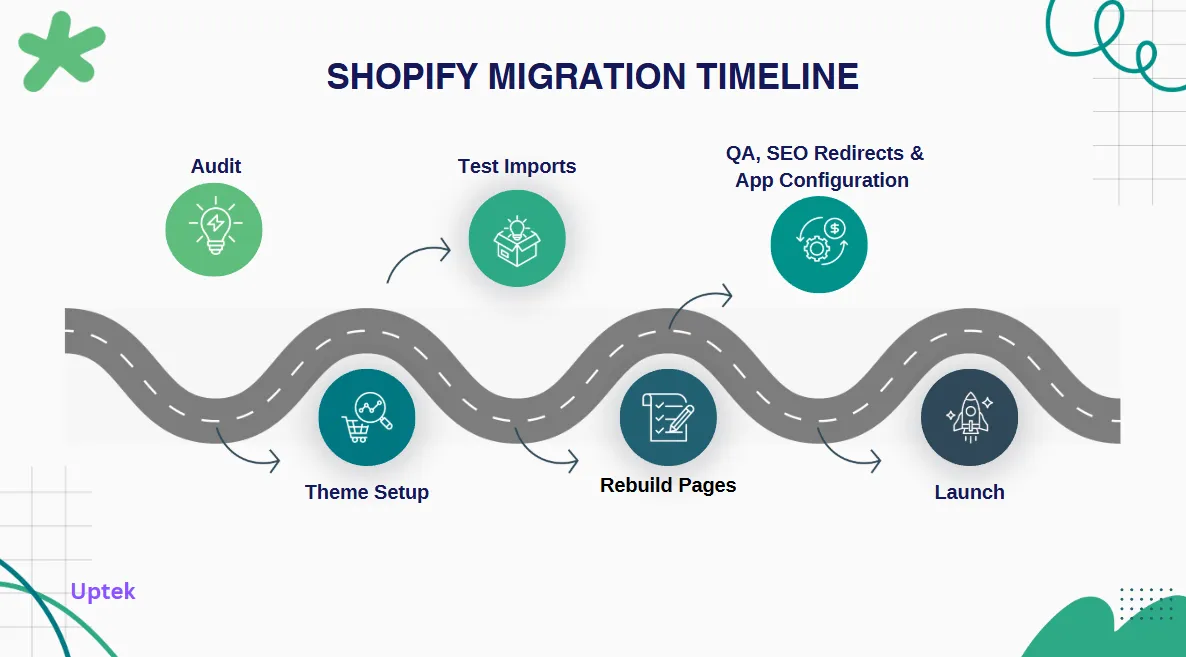
Phased Shopify migration stages roadmap
Deconstructing the "Later" Advantage: Strategic Delay vs. Neglect
The "later" advantage is not about procrastination; it's about intentional sequencing. This strategic deferral involves consciously deciding to postpone non-critical features or complex integrations until post-launch. The goal is to achieve a stable, revenue-generating platform faster.
This approach requires rigorous project management to differentiate between strategic delay and mere neglect. A robust phased implementation plan clearly outlines what features constitute the Minimum Viable Product (MVP) and what will be addressed in subsequent iterations. This prevents foundational elements from being compromised.
The Hidden Costs of All-at-Once: Downtime, Data Loss, and User Experience Erosion
An all-at-once migration carries significant, often underestimated, costs. Extended downtime during a complete platform switch directly impacts revenue and customer trust. Even a few hours can translate into substantial financial losses for a high-volume merchant.
 Strategic technical debt management blueprint
The risk of data loss or corruption is inherently higher with a single, massive transfer. Schema mismatches and incomplete migrations can lead to fractured customer profiles, lost order history, or incorrect inventory counts. This necessitates extensive post-launch data cleanup.
Furthermore, an abrupt, untested launch can severely erode user experience. Bugs, slow page loads, or broken checkout flows immediately alienate customers. The damage to brand reputation and customer loyalty can be long-lasting, far outweighing the perceived efficiency of a rapid deployment.
The Project Management Imperative: Orchestrating Intentional Technical Debt
Effective project management transforms technical debt from a liability into a strategic asset. When undertaking a complex Shopify replatforming project, the decision to incur certain technical debt is a calculated trade-off. It allows for faster time-to-market, enabling immediate revenue generation and real-world user feedback.
This intentional cultivation of technical debt requires precise planning and a clear roadmap for remediation. Without it, strategic deferrals quickly devolve into unmanageable backlogs, threatening long-term platform health. A strong project manager acts as the arbiter, balancing short-term gains with long-term architectural integrity.
Defining "Good" Technical Debt: Features vs. Foundations
"Good" technical debt is a conscious, documented choice to defer specific work, knowing it will be addressed later. This debt typically arises from prioritizing core features and essential foundations over non-critical enhancements. For instance, launching with a simplified loyalty program integration (a feature) to be enhanced later, while ensuring checkout stability (a foundation), is strategic.
Conversely, "bad" technical debt emerges from poor architectural decisions, rushed coding, or a lack of understanding of platform capabilities. This type of debt is unplanned, often unseen, and can cripple scalability and performance. The distinction lies in intent and a clear repayment plan.
Agile Principles in Migration: Iteration, Feedback, and Adaptability
Applying Agile principles to Shopify migrations is crucial for managing strategic technical debt. This involves breaking the migration into small, iterative sprints, allowing for continuous feedback and adaptation. Each sprint focuses on delivering a functional piece of the platform.
This iterative approach enables teams to test hypotheses, gather user data, and pivot as needed, minimizing the impact of unforeseen challenges. Early and frequent releases, even if feature-light, provide invaluable insights into real-world performance and user behavior. This adaptability is a cornerstone of successful Shopify replatforming challenges.
Stakeholder Alignment: Communicating the "Why" Behind Strategic Deferrals
Effective stakeholder management migration is paramount when embracing strategic technical debt. Business leaders, marketing teams, and finance departments must understand the rationale behind phased launches and deferred features. Transparency builds trust and manages expectations.
Clearly articulate the cost-benefit analysis of technical debt. Explain how launching an MVP faster allows for earlier revenue realization and validation, even if it means some features arrive in subsequent phases. This narrative shift from "missing features" to "strategic sequencing" is critical for buy-in. An expert in Shopify Plus consulting can often help bridge this communication gap at the enterprise level, ensuring all parties grasp the strategic implications.
Identifying & Categorizing Technical Debt in Shopify Replatforming
Before you can manage technical debt, you must first identify and categorize it systematically. This process involves a meticulous audit of the new Shopify environment, contrasting its current state against the ideal, fully optimized vision. Categorization helps in prioritizing remediation efforts and allocating resources effectively.
Without a clear understanding of the types and scope of technical debt, repayment efforts become haphazard and inefficient. A structured approach allows for a targeted plan for post-migration optimization.
Code Debt: Customizations, Integrations, and Theme Legacy
Code debt is perhaps the most visible form of technical debt. It includes bespoke customizations that might have been quickly implemented for the MVP but lack long-term maintainability or optimal performance. These could be custom Liquid snippets, JavaScript functionalities, or app integrations.
Legacy theme code, even if migrated, can contribute to significant code debt. Outdated themes, or those not optimized for Shopify's Online Store 2.0 architecture, can hinder performance and limit future feature development. A dedicated Shopify theme optimization strategy is often necessary to address this.
Integrations, especially complex ERP or CRM systems, might initially be implemented with basic functionality. Full, bi-directional syncs or advanced data flows could be deferred, creating integration debt that needs careful planning for later phases. This requires a robust roadmap for the Shopify transition.
Data Debt: Incomplete Migrations, Schema Mismatches, and Cleanup
Data debt arises when not all historical data is migrated, or when data is transferred imperfectly. This can manifest as incomplete customer profiles, missing order histories, or product data discrepancies. Often, a "later migration" of non-essential historical data is a strategic choice to accelerate the initial launch.
Schema mismatches between the old platform and Shopify can lead to data fragmentation. For example, custom fields from a previous platform might not map cleanly to Shopify's default structure, requiring workarounds that become debt. Post-launch data cleanup becomes essential to ensure data integrity and accurate reporting.
Process Debt: Documentation Gaps and Workflow Inefficiencies
Process debt refers to the lack of proper documentation for new configurations, customizations, or workflows. In a fast-paced phased implementation plan, documenting every decision and technical detail might be temporarily deprioritized to hit launch targets. This creates a reliance on institutional knowledge, making future maintenance difficult.
Workflow inefficiencies also contribute to process debt. If new operational processes, necessitated by the Shopify platform, are not fully optimized or automated, they create manual overhead. This could include order fulfillment processes, inventory management, or customer service protocols that need refinement post-launch.
The Project Manager's Toolkit: Strategies for Managing & Repaying Debt
Managing strategic technical debt is an ongoing process, not a one-time fix. Project managers need a specific toolkit and methodology to track, prioritize, and systematically repay this debt. This ensures that the platform remains healthy and scalable without being crippled by accumulated technical burdens.
A proactive approach prevents debt from spiraling out of control, maintaining the initial benefits of a phased launch. This requires continuous monitoring and dedicated resource allocation.
Prioritization Frameworks: Impact vs. Effort Matrix for Debt Backlogs
To effectively manage a technical debt backlog, a prioritization framework is indispensable. The "Impact vs. Effort Matrix" is particularly useful. This matrix helps categorize debt items based on their potential impact on performance, stability, or user experience, versus the effort required to fix them.
Items with high impact and low effort should be addressed first, offering quick wins and significant improvements. High-impact, high-effort items require strategic planning and dedicated resources. Low-impact items can be deferred or batched for later sprints. This framework ensures that resource allocation for migrations is optimized.
Dedicated "Debt Sprints": Allocating Resources for Remediation
One of the most effective strategies for repaying technical debt is to schedule dedicated "debt sprints." These are specific development cycles where the team's primary focus is on addressing items from the technical debt backlog, rather than developing new features. This prevents debt from accumulating indefinitely.
Here are the core steps for running effective debt sprints:
- Audit & Categorize: Regularly review the platform to identify and categorize new and existing technical debt.
- Prioritize: Apply the Impact vs. Effort matrix to rank debt items.
- Allocate Resources: Dedicate a specific team or individuals to the debt sprint, ensuring they have the necessary expertise.
- Define Scope: Clearly define the specific debt items to be addressed within the sprint, setting realistic goals.
- Execute & Test: Implement the fixes and rigorously test them to ensure stability and prevent regressions.
- Document: Update documentation for any changes made, reducing future process debt.
- Review & Refine: Conduct a post-sprint review to assess effectiveness and refine the debt management process.
Automation & Tooling: Streamlining Debt Identification and Resolution
Leveraging automation and specialized tooling can significantly streamline the identification and resolution of technical debt. Code quality tools, performance monitoring systems, and automated testing frameworks can continuously scan the Shopify environment for issues. These tools provide real-time insights into potential problems, allowing for proactive intervention.
For example, tools that monitor page speed, Lighthouse scores, or broken links can highlight performance implications of debt. Automated testing can identify regressions introduced by new features or debt repayment efforts. Integrating these tools into the development pipeline ensures continuous vigilance.
Measuring the ROI of Strategic Technical Debt Management
The decision to embrace strategic technical debt, and subsequently manage it, must be justified by a clear return on investment (ROI). This isn't just about avoiding catastrophic failures; it's about optimizing business outcomes and ensuring long-term platform viability. Quantifying these benefits helps secure ongoing executive buy-in for post-migration optimization efforts.
A comprehensive cost-benefit analysis of technical debt reveals the true value of this strategic approach. It moves beyond anecdotal evidence to data-driven justification.
Quantifying the Benefits: Faster Time-to-Market and Reduced Initial Costs
The most immediate and quantifiable benefit of strategic technical debt is a significantly faster time-to-market. By launching an MVP with core functionalities, merchants can start generating revenue sooner. This acceleration can be measured by comparing the actual launch date against a hypothetical all-at-once launch scenario.
Reduced initial project costs are another direct benefit. Deferring complex integrations or non-critical features means a smaller initial development scope, requiring fewer resources upfront. This allows capital to be allocated more efficiently, potentially funding iterative improvements from early revenue. This provides a compelling case for a Shopify migration service that champions phased rollouts.
Mitigating Future Risks: Proactive Maintenance vs. Reactive Fixes
Strategic technical debt management shifts the paradigm from reactive firefighting to proactive maintenance. By systematically repaying debt, the platform's stability and security are continuously improved. This reduces the likelihood of critical outages, security vulnerabilities, or performance bottlenecks.
The cost of reactive fixes is often exponentially higher than proactive maintenance. Emergency patches, lost revenue during downtime, and reputational damage far outweigh the investment in scheduled debt repayment. A well-managed debt strategy acts as a long-term risk management plan.
Long-Term Scalability and Performance Gains
A clean, well-maintained codebase, free from accumulating technical debt, is inherently more scalable. As a business grows, the Shopify platform needs to handle increased traffic, product catalogs, and transactional volume. Unmanaged technical debt can quickly become a bottleneck, leading to performance implications of debt.
By addressing code and process debt, the platform becomes more agile and responsive to future business needs. This ensures that the initial investment in Shopify continues to yield returns, supporting ambitious growth trajectories without requiring another costly replatforming in the near future. This is a critical scalability consideration for Shopify.
Case Study Snippets: Real-World Applications of the "Later" Advantage
Theory is valuable, but real-world examples solidify understanding. These brief case studies illustrate how enterprise merchants and scaling brands have successfully leveraged strategic technical debt and phased migrations to achieve their e-commerce goals. They demonstrate the practical application of the "later" advantage.
These examples highlight how intentional deferral, combined with robust project management, leads to successful outcomes. They underscore the importance of a well-defined migration strategy planning.
E-commerce Brand X: Launching with Core Features, Iterating on Integrations
E-commerce Brand X, a rapidly growing direct-to-consumer apparel company, faced a complex replatforming from a legacy system to Shopify Plus. Their initial plan involved migrating all existing ERP, CRM, and 3PL integrations simultaneously with the store launch. This presented a significant risk of delays and integration failures.
Instead, they opted for a phased approach. The MVP launched with essential product data, a simplified checkout, and basic inventory sync. Complex, custom integrations with their legacy ERP and advanced analytics platforms were strategically deferred to post-launch sprints. This allowed them to go live within three months, generating revenue immediately. Over the next six months, dedicated development sprints systematically tackled the deferred integrations, leveraging real-world sales data to refine requirements.
Retailer Y: Phased Data Migration to Minimize Customer Disruption
Retailer Y, a multi-channel retailer with a vast customer database and extensive historical order data, needed to migrate to Shopify. The sheer volume and complexity of their data posed a significant challenge for a single cutover. A full data migration would have required prolonged downtime and risked data integrity issues.
Their strategy involved a phased data migration. The initial Shopify launch included only current product inventory and active customer accounts with recent order history. Older, archived customer data and historical order records beyond a certain timeframe were migrated in batches during off-peak hours over several weeks post-launch. This minimized the initial cutover window to just a few hours and ensured customer disruption was virtually nonexistent. The "later migration" of historical data allowed them to prioritize customer experience and platform stability.
Frequently Asked Questions
What is the "Later Advantage" in Shopify migrations?
The 'Later Advantage' in Shopify migrations refers to a strategic approach where non-critical features, complex integrations, or extensive historical data migrations are intentionally deferred until after an initial Minimum Viable Product (MVP) launch. This calculated deferral is not procrastination but a deliberate project management decision aimed at accelerating time-to-market, enabling immediate revenue generation, and gathering real-world user feedback on a stable core platform. By prioritizing foundational elements and essential functionalities for the initial Shopify transition, businesses can significantly reduce the risks associated with a monolithic 'big bang' launch, such as extended downtime, data corruption, or poor user experience. This strategic incurrence of technical debt is then systematically addressed in subsequent, planned development sprints, transforming potential liabilities into manageable, long-term optimization efforts that ensure platform health and scalability.
How does project management prevent "bad" technical debt during a Shopify transition?
Effective project management is crucial for differentiating between strategic technical debt (good debt) and unplanned, detrimental debt (bad debt). It establishes clear phased implementation plans, defines the MVP scope, and creates a precise roadmap for future remediation. Through rigorous planning, stakeholder alignment, and the application of Agile principles, project managers ensure that any deferred work is a conscious, documented choice with a repayment strategy, preventing it from devolving into unmanageable backlogs that compromise platform integrity and scalability.
What are the main types of technical debt encountered in Shopify replatforming?
In Shopify replatforming, technical debt typically falls into three main categories: Code Debt, Data Debt, and Process Debt. Code debt includes bespoke customizations, legacy theme code, or initial basic integrations that lack long-term maintainability. Data debt arises from incomplete historical data migrations, schema mismatches between platforms, or the need for extensive post-launch data cleanup. Process debt refers to gaps in documentation for new configurations and workflows, or inefficiencies in operational processes necessitated by the new Shopify environment.

Ecommerce manager, Shopify & Shopify Plus consultant with 10+ years of experience helping enterprise brands scale their ecommerce operations. Certified Shopify Partner with 130+ successful store migrations.

