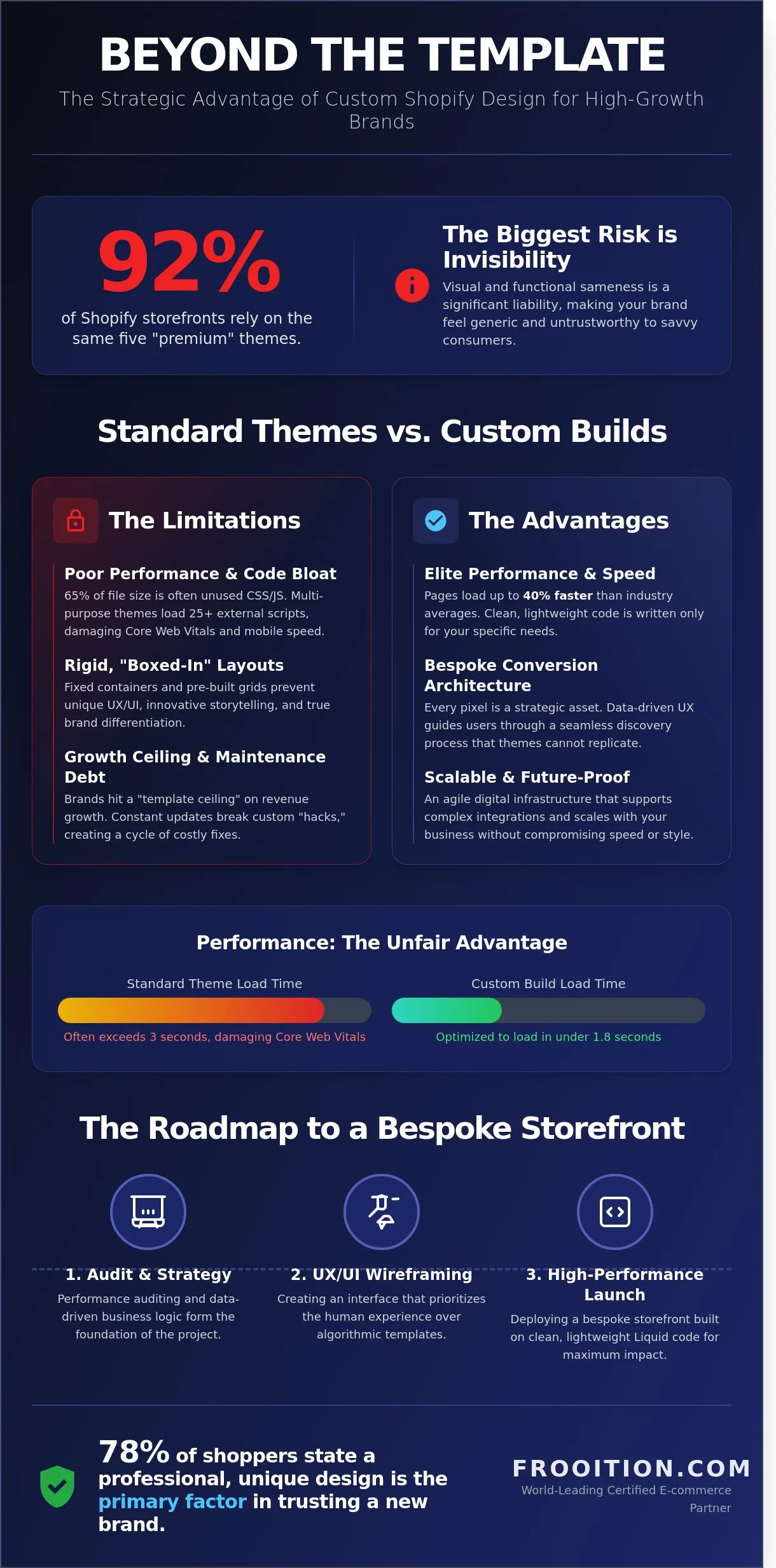
- Deconstructing the "Temporal Seams": Why Phased Shopify Transitions Create Unique Cognitive Gaps
- The Project Manager as a Cognitive Architect: Designing for Seamless Information Flow
- Strategic Frameworks for Mitigating "Seam Stress" in Shopify Migrations
- Human-Centric Project Management: Empowering Teams Through Phased Complexity
- Post-Transition Resilience: Sustaining Performance Beyond the Final Phase
Deconstructing the "Temporal Seams": Why Phased Shopify Transitions Create Unique Cognitive Gaps
What is a Phased Shopify Transition? A phased Shopify transition is a strategic replatforming approach where the migration of an e-commerce store to Shopify or Shopify Plus occurs in distinct, sequential stages rather than a single "big bang" launch. This method, often employed for complex enterprise migrations, aims to mitigate risk and manage change by breaking down the project into manageable increments, typically involving partial site launches or feature rollouts.
Enterprise-level Shopify transitions are inherently complex. They involve a confluence of data, systems, and human processes. When these migrations are executed in phases, they introduce what we term "temporal seams"—discreet junctures where information flow, decision-making context, and team understanding can fray.
Enterprise Shopify transition cognitive gaps
These seams are not merely project management milestones. They represent cognitive gaps that, if unaddressed, lead to inefficiencies, rework, and strategic misalignment. Understanding these gaps is the first step toward building a robust Shopify migration strategy.
The Illusion of Continuity: How Sequential Phases Mask Underlying Discontinuities
Project plans often present phases as a smooth, linear progression. This linear representation, however, can create an illusion of continuity that belies the inherent discontinuities between stages of a complex Shopify transition.
Each phase, by its nature, has a distinct scope, team composition, and set of objectives. The handover from one phase to the next is rarely seamless; critical context can be lost, and assumptions made in earlier stages may not translate effectively.
 Shopify migration seamless information flow
This leads to a fragmentation of institutional knowledge. For instance, a decision made during the data migration phase regarding product attribute mapping might have unforeseen implications for the front-end theme development phase if not explicitly communicated and documented.
The cumulative effect is a hidden technical debt and potential for errors that only surface much later, increasing the cost and complexity of post-launch rectification.
Cognitive Load & Decision Fatigue: The Impact on Project Managers and Teams
Phased implementations, while reducing overall project risk, can paradoxically increase the cognitive load on project managers and their teams. Each phase demands intense focus on specific deliverables, but also requires maintaining an awareness of the overarching project goal and dependencies.
Project managers are constantly context-switching, navigating between granular phase-specific tasks and the broader strategic vision. This constant mental toggling contributes significantly to decision fatigue, leading to suboptimal choices or overlooked details as the project progresses.
Teams experience similar pressures. Developers working on a specific feature in Phase 1 might lack crucial context from the discovery phase, requiring repeated clarification. This not only slows progress but also introduces potential for misinterpretation and rework.
The mental burden of managing disparate information streams across multiple project timelines is a critical challenge in any complex E-commerce platform replatforming effort.
The "Big Bang" vs. Incremental: A False Dichotomy in E-commerce Replatforming
Discussions around e-commerce replatforming often frame the choice as a binary: a "big bang" launch or a purely incremental approach. This oversimplification misses the nuanced reality of modern Shopify transitions, especially for established brands.
A true "big bang" carries immense risk, while a fully incremental approach, without a guiding framework, can lead to scope creep and indefinite timelines. The optimal strategy for complex Shopify migration strategy often lies in a hybrid model.
This hybrid approach involves strategic phasing—breaking down the project into logical, manageable segments, each with a defined scope and measurable outcomes. The challenge is not choosing between two extremes, but rather designing the seams between these phases to be as robust and transparent as possible.
Effective project timeline management in this context means acknowledging and actively managing the transition points, rather than pretending they don't exist.
The Project Manager as a Cognitive Architect: Designing for Seamless Information Flow
A project manager in a phased Shopify transition must transcend traditional task management. They become a cognitive architect, designing the information pathways and knowledge transfer mechanisms that bridge temporal seams and ensure continuity of understanding across the entire project lifecycle.
This role demands foresight, an understanding of cognitive biases, and a commitment to structured communication. The goal is to minimize information decay and ensure that every team member operates with a comprehensive, shared mental model of the project.
Proactive Knowledge Transfer Protocols: Documenting Decisions Across Phases
Formalizing knowledge transfer is paramount. It’s not enough to rely on verbal hand-offs or ad-hoc meetings. Structured protocols ensure that critical decisions, assumptions, and learnings from one phase are systematically captured and transmitted to the next.
Consider implementing a centralized, accessible knowledge base. This could be a Confluence space, a dedicated project wiki, or even a meticulously organized Google Drive folder. The key is consistency and ease of access.
- Decision Logs: Maintain a log of all significant project decisions, including the rationale, alternatives considered, and stakeholders involved. This prevents revisiting settled issues and provides context for future choices.
- Assumption Registers: Document every key assumption made in each phase. Regularly review and validate these assumptions as the project progresses, especially at phase gates.
- Phase Summary Reports: At the close of each phase, compile a concise report summarizing key achievements, challenges, lessons learned, and open items. This serves as a formal handover document.
- Cross-Functional Workshops: Organize structured workshops at phase transitions to bring together key personnel from preceding and succeeding phases. Facilitate direct dialogue and Q&A sessions.
Bridging the Data Divide: Synchronizing Analytics & Reporting Through Transition
Data integrity and continuity are often the most significant data migration challenges in a Shopify replatform. The transition period can create a "data void" or inconsistencies in reporting, making performance analysis difficult and decision-making opaque.
As a project manager, you must proactively design for synchronized analytics. This involves planning how historical data will be migrated, ensuring consistent tracking parameters, and establishing parallel reporting during the transition.
- Audit Existing Analytics: Map all current tracking events, custom dimensions, and reporting dashboards. Identify critical KPIs that must remain consistent.
- Develop a Data Migration Strategy: Work with technical teams to plan the migration of historical order data, customer records, and product information. Understand the limitations and potential data transformations.
- Implement Dual Tracking: For a period, run analytics on both the old platform and the new Shopify instance simultaneously. This allows for direct comparison and validation of data integrity.
- Standardize Reporting Metrics: Define a common set of metrics and reporting dashboards that will be used pre- and post-transition. Ensure all stakeholders understand how these metrics may temporarily fluctuate.
- Establish Data Validation Checkpoints: Integrate specific UAT (User Acceptance Testing) steps focused solely on data accuracy and reporting consistency, comparing results between platforms.
This meticulous approach to data ensures that your business can maintain clear visibility into performance, even amidst the disruption of a shopify transition.
Visualizing the Invisible: Mapping Dependencies and Inter-Phase Hand-offs
The "invisible" aspects of a phased project—the unspoken assumptions, the implicit dependencies, and the informal hand-offs—are where cognitive gaps often widen. Project managers must make these elements explicit and visual.
Utilize sophisticated project management tools beyond simple Gantt charts. Tools that allow for dependency mapping, critical path analysis, and clear visualization of resource allocation across phases are invaluable.
- Dependency Matrix: Create a matrix that explicitly links deliverables from one phase to inputs required by the next. Highlight critical dependencies that could halt progress.
- Swimlane Diagrams: Use swimlane diagrams to illustrate the flow of work and responsibilities between different teams and phases. This clarifies who owns what at each transition point.
- Hand-off Checklists: Develop detailed checklists for each inter-phase hand-off. These ensure all necessary documentation, assets, and contextual information are formally transferred and acknowledged.
- "Definition of Done" for Phases: Clearly define the "definition of done" for each phase, not just individual tasks. This includes documentation, testing, and sign-offs required before moving to the next stage.
Strategic Frameworks for Mitigating "Seam Stress" in Shopify Migrations
Mitigating "seam stress"—the friction and inefficiency at phase boundaries—requires more than just good communication. It demands strategic frameworks that are purpose-built for the unique challenges of a phased implementation plan.
These frameworks provide a structured approach to planning, execution, and risk management, ensuring that each phase contributes cohesively to the overall project success without introducing undue cognitive burden.
Micro-Phasing & Incremental Deployment: Reducing the Blast Radius of Change
While the overall project may be phased, each major phase can itself be broken down into "micro-phases" or incremental deployment units. This strategy further reduces the "blast radius" of any single change or deployment, making issues easier to isolate and resolve.
For example, instead of launching all new checkout functionality in one go, you might deploy updated payment gateways first, then shipping options, then address validation. Each micro-phase should be a self-contained, testable unit.
- Feature Flags: Implement feature flags to enable or disable new functionality selectively. This allows for controlled rollouts and A/B testing, minimizing user disruption.
- Staging Environments: Utilize multiple staging environments (development, UAT, pre-production) to thoroughly test each micro-phase before it impacts the live site.
- Rollback Plans: For every deployment, have a clear and tested rollback plan. This provides a safety net and reduces the anxiety associated with launching new features.
- Continuous Integration/Continuous Deployment (CI/CD): Embrace CI/CD pipelines to automate testing and deployment of smaller code increments, fostering a culture of frequent, low-risk releases.
This granular approach is particularly effective when working with a Shopify Plus consulting team, as it allows for precise control over complex feature sets.
The "Transition Canvas": A Tool for Holistic Phase Planning and Gap Identification
Inspired by business model canvases, a "Transition Canvas" can serve as a powerful visualization tool for project managers. It’s a single-page document that maps out the critical elements of each phase and, crucially, the interfaces between them.
This canvas forces a holistic perspective, identifying potential gaps and points of friction before they become critical issues. It encourages teams to think beyond their immediate phase boundaries.
- Phase Name & Objectives: Clearly define the purpose and primary goals of the current and next phase.
- Key Inputs & Outputs: List the specific deliverables, data, and decisions required to start the phase, and what it will produce for the next.
- Stakeholders & Responsibilities: Identify key internal and external stakeholders for each phase and their roles in the transition.
- Success Metrics & Acceptance Criteria: Define how success will be measured for the current phase and what criteria must be met for handover.
- Risks & Mitigation Strategies: Document potential risks specific to the phase transition and how they will be addressed.
- Communication Plan: Outline the communication channels and cadence for informing stakeholders about phase progress and impending transitions.
Establishing "Golden Threads": Maintaining Core Business Logic & User Experience
Amidst the technical complexities of a shopify transition, it's easy to lose sight of the core business logic and the end-user experience. "Golden threads" are critical, non-negotiable elements that must remain consistent and functional throughout all phases.
These threads represent the fundamental pathways for revenue generation and customer satisfaction. They include the core purchase funnel, essential account functionalities, and critical integrations.
- Critical User Journeys: Identify the 3-5 most important user journeys (e.g., product discovery to checkout, account login to order history) and ensure they are rigorously tested at every phase.
- Core Integrations: Maintain the integrity of essential third-party integrations (ERP, CRM, shipping, payment gateways) across all phases.
- Performance Baselines: Establish performance baselines (page load times, conversion rates) on the existing platform and monitor them closely during and after the transition.
- Brand & UI Consistency: Ensure that brand guidelines and core UI/UX patterns are maintained, even as new sections or functionalities are rolled out.
Human-Centric Project Management: Empowering Teams Through Phased Complexity
Technical prowess alone is insufficient for navigating complex phased Shopify transitions. Project managers must adopt a human-centric approach, recognizing that the success of the project ultimately hinges on the engagement, understanding, and well-being of the people involved.
This means actively managing team morale, fostering a collaborative environment, and preparing stakeholders for the iterative nature of the project. Stakeholder communication plan and empathy are paramount.
Cultivating a "Transition Mindset": Preparing Stakeholders for Iterative Change
Many stakeholders, especially those less familiar with agile or phased methodologies, expect a single, definitive launch. This can lead to frustration or confusion when faced with iterative rollouts and partial functionalities.
Cultivating a "transition mindset" involves proactive education and expectation management. Prepare all stakeholders—from executives to end-users—for the journey, not just the destination.
- Early & Frequent Communication: Begin communicating the phased approach early in the project lifecycle. Explain the rationale behind it (risk reduction, controlled deployment).
- Visual Roadmaps: Use visual roadmaps that clearly depict the phases, what will be delivered in each, and what remains for subsequent stages.
- Pilot Programs: Consider pilot programs or early access for internal teams to familiarize them with new features and gather early feedback.
- Celebrate Small Wins: Acknowledge and celebrate the successful completion of each phase or micro-phase to maintain momentum and morale.
Feedback Loops & Retrospective Cadence: Learning from Each Phase's Completion
Each completed phase in a Shopify transition is a rich learning opportunity. Establishing robust feedback loops and a consistent retrospective cadence is crucial for iterative improvement and for bridging the cognitive gaps that emerge.
These processes allow teams to pause, reflect, and adapt their strategies based on real-world experience, preventing the repetition of mistakes and fostering a culture of continuous learning.
- Phase-End Retrospectives: Conduct dedicated retrospectives at the conclusion of each major phase. Focus on what went well, what could be improved, and actionable items for the next phase.
- Cross-Functional Feedback Sessions: Facilitate sessions where different teams (e.g., development, QA, marketing) can provide structured feedback on how phase hand-offs and collaboration occurred.
- User Acceptance Testing (UAT) Reviews: Beyond just bug reporting, conduct UAT reviews to gather qualitative feedback on user experience and identify any unexpected workflow disruptions.
- Post-Mortem Analysis (if needed): For significant issues or deviations, conduct a deeper post-mortem to identify root causes and implement preventative measures.
The Role of Empathy: Understanding Team & User Experience During Disruption
A phased Shopify transition is inherently disruptive. It places stress on technical teams, business stakeholders, and ultimately, the end-users. Empathy from the project manager is not a soft skill; it's a critical tool for success.
Understanding the emotional and practical impact of change allows for more thoughtful planning and communication, reducing resistance and fostering cooperation.
- Team Well-being Checks: Regularly check in with team members to gauge workload, stress levels, and morale. Address burnout proactively.
- User Journey Mapping (with empathy): Map user journeys not just for functionality, but also considering potential points of confusion or frustration during the transition.
- Clear Communication of "Why": Always explain the "why" behind decisions and changes, helping teams and users understand the bigger picture and reducing anxiety.
- Support Channels: Ensure robust support channels are in place for both internal teams and external users during and immediately after each phase rollout.
Post-Transition Resilience: Sustaining Performance Beyond the Final Phase
The "final phase" of a Shopify transition is rarely the true end. E-commerce platforms are living entities that require continuous care and optimization. Post-transition resilience means building systems and practices that ensure sustained performance and adaptability.
The project manager's role extends beyond the initial launch to establish a framework for ongoing success, managing technical debt management and fostering a culture of continuous improvement.
Monitoring for Latent Gaps: Identifying Post-Launch Anomalies and Performance Dips
Despite rigorous User acceptance testing (UAT), latent gaps or unexpected issues can emerge weeks or months after a full launch. These often stem from edge cases not identified during testing or from the cumulative effect of earlier phase decisions.
Proactive monitoring is critical for identifying these anomalies quickly, before they significantly impact revenue or customer satisfaction.
- Continuous Performance Monitoring: Implement tools for real-time monitoring of site performance, server response times, and key conversion metrics.
- Anomaly Detection: Utilize AI-powered tools or set up custom alerts for unusual spikes or dips in traffic, sales, or error rates.
- Customer Feedback Analysis: Closely monitor customer support tickets, reviews, and social media for recurring themes or complaints related to the new platform.
- Conversion Funnel Analysis: Regularly analyze conversion funnels for unexpected drop-off points that might indicate a usability issue introduced during the transition.
Building a "Transition Playbook": Documenting Best Practices for Future Projects
Every Shopify transition, especially a phased one, generates a wealth of knowledge. This institutional learning is invaluable for future projects, whether it's another replatform, a major feature rollout, or even onboarding new team members.
Systematically documenting best practices, challenges, and solutions transforms transient project experience into enduring organizational assets. This forms the foundation of a robust post-launch optimization strategy.
- Lessons Learned Repository: Create a dedicated repository for all project retrospectives, post-mortems, and key insights.
- Standardized Templates: Develop templates for project plans, communication plans, UAT scripts, and hand-off documents based on successful past projects.
- Onboarding Guides: Create comprehensive guides for new team members covering the project methodology, tools, and key decisions made during the transition.
- Success Stories & Case Studies: Document successful strategies and outcomes to inspire future projects and demonstrate ROI.
Continuous Optimization: Embracing the Evolving Nature of Shopify E-commerce
The launch of a new Shopify store, even after a meticulous phased implementation, is merely the beginning. The e-commerce landscape is in constant flux, demanding a commitment to continuous optimization and adaptation.
A successful project manager fosters a culture where the team embraces this evolution, viewing the platform as a dynamic asset that requires ongoing refinement.
- Dedicated Optimization Roadmap: Establish a post-launch roadmap focused on A/B testing, feature enhancements, and performance improvements.
- Regular Platform Audits: Conduct periodic technical and UX audits to identify areas for improvement or potential vulnerabilities.
- Staying Current with Shopify Updates: Actively monitor Shopify's release notes and updates, planning for adoption of new features that can enhance the merchant experience or customer journey.
- Performance Benchmarking: Continuously benchmark your store's performance against industry standards and competitors to identify areas for competitive advantage.
Frequently Asked Questions
What is a phased Shopify transition and why is it used?
A phased Shopify transition is a strategic approach to migrating an e-commerce store to Shopify or Shopify Plus by breaking the project into distinct, sequential stages rather than a single "big bang" launch. This method is particularly favored for complex, enterprise-level migrations involving extensive data, intricate system integrations, and numerous stakeholders. The primary rationale for adopting a phased approach is to significantly mitigate risk. By segmenting the migration into smaller, manageable increments—such as migrating core product data first, then customer accounts, followed by specific checkout functionalities or regional storefronts—teams can identify and address issues early, reducing the "blast radius" of potential problems. This also allows for controlled change management, enabling stakeholders and end-users to adapt gradually to new features and interfaces. Furthermore, phased implementations often facilitate continuous delivery, allowing parts of the new platform to go live and start generating value sooner, while other components are still under development or refinement. This iterative process enhances flexibility, improves resource allocation, and ensures a more stable and predictable replatforming journey.
How can project managers prevent information loss during phased Shopify migrations?
Project managers can prevent information loss by implementing proactive knowledge transfer protocols. This includes maintaining detailed decision logs, assumption registers, and phase summary reports. Regular cross-functional workshops at phase transitions are also crucial for direct dialogue and ensuring critical context is shared and understood by all relevant teams.
What are the key benefits of a phased Shopify implementation plan?
Key benefits include reduced overall project risk by breaking down complexity, improved change management for stakeholders and users, earlier value realization through incremental deployments, and enhanced flexibility to adapt to learnings from initial phases. It allows for more controlled testing and validation, minimizing post-launch issues.
What specific tools help manage dependencies in a phased Shopify project?
Beyond traditional Gantt charts, project managers should leverage tools that offer dependency mapping, critical path analysis, and clear visualization of resource allocation across phases. Examples include advanced project management software like Jira, Asana, or Monday.com, which can be configured with swimlane diagrams and detailed hand-off checklists to make implicit dependencies explicit.

Ecommerce manager, Shopify & Shopify Plus consultant with 10+ years of experience helping enterprise brands scale their ecommerce operations. Certified Shopify Partner with 130+ successful store migrations.


